Graphic design is two jobs wearing one title, and only one of them is compressing. So when someone asks will AI replace graphic designers, the useful answer starts by splitting the work in half rather than defending or attacking the whole occupation.
Execution work, the part with a correct answer, is compressing fast. Judgment work, where someone decides what the brand should look like and then holds that line across a year of output, is not compressing at all. Employment projections show the occupation roughly flat rather than collapsing, with heavy annual churn underneath. The exposure is not spread evenly: a designer who only executes sits in a very different position from one who owns the standard.
Graphic Design Is Two Kinds of Work
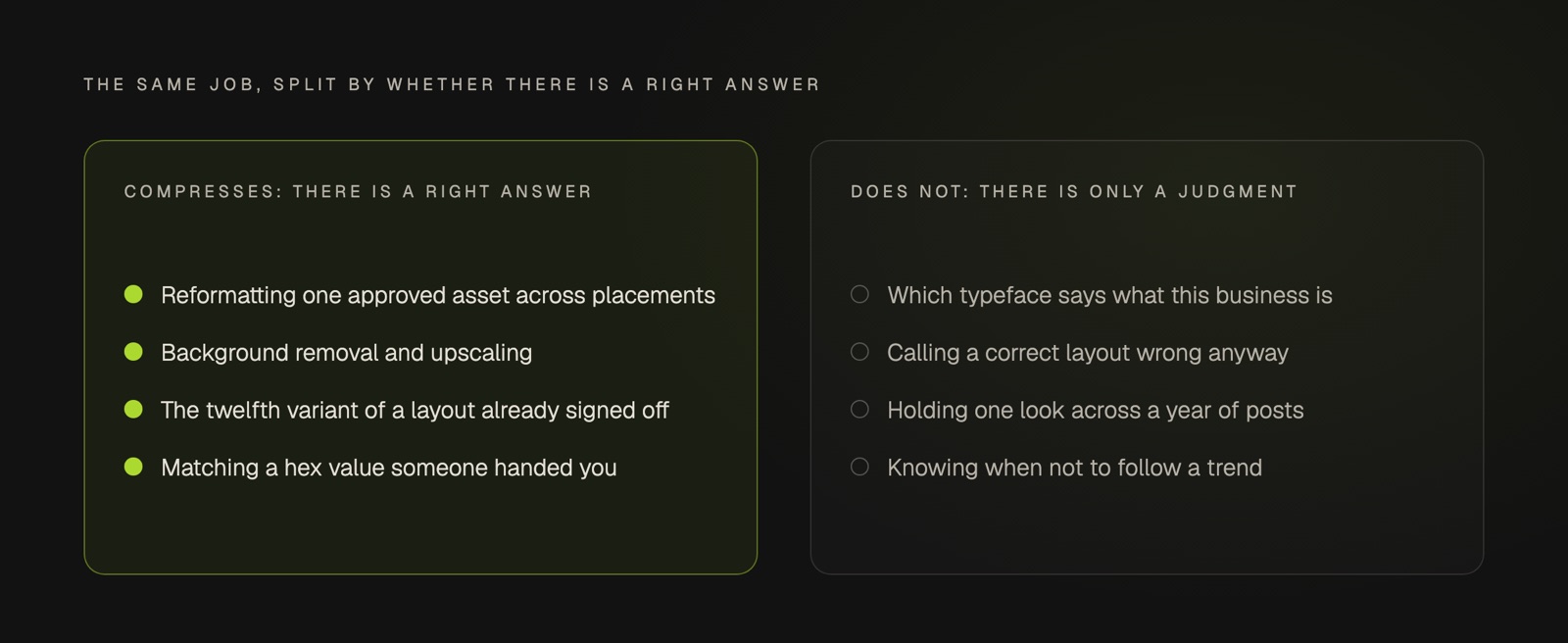
Execution is the design work that has a correct answer. Removing a background, resizing a layout from square to portrait, matching a hex value, building the twelfth variant of an ad in a different aspect ratio, tracing a logo back into vector. You can tell by looking whether it was done right, and two competent people would do it the same way.
Judgment is the design work that has no correct answer, only a defensible one. Which typeface says what this business is. Whether the new campaign still looks like the brand or has quietly drifted somewhere else. Whether a layout that technically works is actually any good. Nobody can check that against a specification, because the specification is the thing being decided.
Most arguments about design and automation go wrong by treating those two as one skill. They have different inputs, different failure modes, and right now, very different economics.
Will AI Replace Graphic Designers Doing Production Work?
For that slice, largely yes, and pretending otherwise helps nobody. Background removal, upscaling, reformatting one asset into eight placements, generating twenty headline variants to choose between. These are jobs with a checkable answer, which is exactly the condition under which design automation performs well. A task that used to be an afternoon is now a button.
That compression is mostly good news for the people doing the work, and genuinely bad news for anyone whose entire billable value was production speed. Freelance production is the most exposed category, because it is bought by the task rather than by the relationship. When the task takes four minutes, the invoice follows it down.
What does not follow is the assumption that the output is finished. A generated asset is a proposal. Somebody still has to decide it is right, and that somebody is doing the other job.
What the Employment Numbers Actually Say
The United States Bureau of Labor Statistics puts employment of graphic designers at 265,900 in 2024, projected to grow 2 percent through 2034, an increase of 5,700 positions, with about 20,000 openings a year across the decade, most of them from workers moving to other occupations or retiring rather than from growth. Median pay was $61,300.
That is neither a collapse nor a boom. It is an occupation holding roughly still while a large number of people cycle through it every year. If automation were erasing the job outright, the projection would show a decline. If it were purely additive, growth would sit well above average. Neither is what the numbers describe, which is what you would expect if one half of the work were disappearing and the other half were not.
Will AI Replace Graphic Designers Who Set the Standard?
No, and the reason is structural rather than sentimental. A model generates one thing at a time with no record of what it made for you last week, which is why a month of individually competent assets can still fail to look like one brand. We traced that failure in detail in what AI graphic design makes well and what it forgets. The gap it leaves is not a skill gap that the next model version closes. It is a memory and authority gap, and closing it means someone holds a standard and enforces it against output that is always slightly willing to drift.
That work has a shape in practice even where it has no job title. It is deciding what the brand identity is, writing it down precisely enough that it can be checked, and then rejecting the version that came back wrong. Taste is the unglamorous part: looking at something competent and saying it is not right, and being correct about that often enough that people stop arguing.
Where this gets uncomfortable is that the protection is not attached to the title. It is attached to which half of the work you actually own. A designer who has spent ten years executing other people's decisions is more exposed than a designer with two years and real judgment.
Key Takeaways
- Split the occupation before answering. Execution and judgment are compressing at completely different rates.
- Execution has a correct answer, which is precisely the condition that automates well.
- Judgment has no correct answer to converge on, so it stays with a person.
- Projected employment is close to flat rather than falling, with high annual turnover underneath it.
- Exposure tracks the half of the work you own, not the title on the contract.
- A generated asset is a proposal until somebody with a standard accepts it.
Frequently Asked Questions
Will AI replace graphic designers completely?
No. The version of will AI replace graphic designers that is actually coming true is narrower than the headline: production tasks with a checkable answer get absorbed, while the deciding does not. What disappears is a set of tasks rather than an occupation, and the employment projections are consistent with that reading.
Which design tasks are most exposed to automation?
Anything with a specification and a right answer. Reformatting one asset across placements, background removal, upscaling, colour correction, producing variants of an already approved layout, and early concepting where quantity matters more than any single result. The common thread is that a second competent person would have produced roughly the same thing, so there was never much judgment in it to lose. Tasks that need knowledge of your customer, your positioning or your own back catalogue are the least exposed.
What should a business with no designer do about this?
Write the standard down before you generate anything. Typeface, colour values, logo placement, and what the brand does not do, held somewhere a person or a system can check finished output against. Tools will happily hand you a different look every week if nothing is holding them still, which is the test we applied when comparing AI tools for graphic design. The decision to make is who owns the standard, not which generator to buy.
Conclusion: Own the Judgment, Automate the Execution
The version of will AI replace graphic designers that is actually happening is quieter than either side of the argument wants it to be. Execution is being compressed toward nothing, and that is genuinely good. Judgment is not compressing, because there is no correct answer for a model to converge on, and a business with nobody holding the standard now produces drift faster than it ever could before.
So the useful move is not picking a side. It is knowing which half of the work sits with you, writing that half down as a documented brand blueprint precise enough to check against, and letting the other half get cheap. For a small business with nobody on staff who does this, that ownership question is the whole decision. If holding the line every week is the part that keeps slipping, that is worth a look.