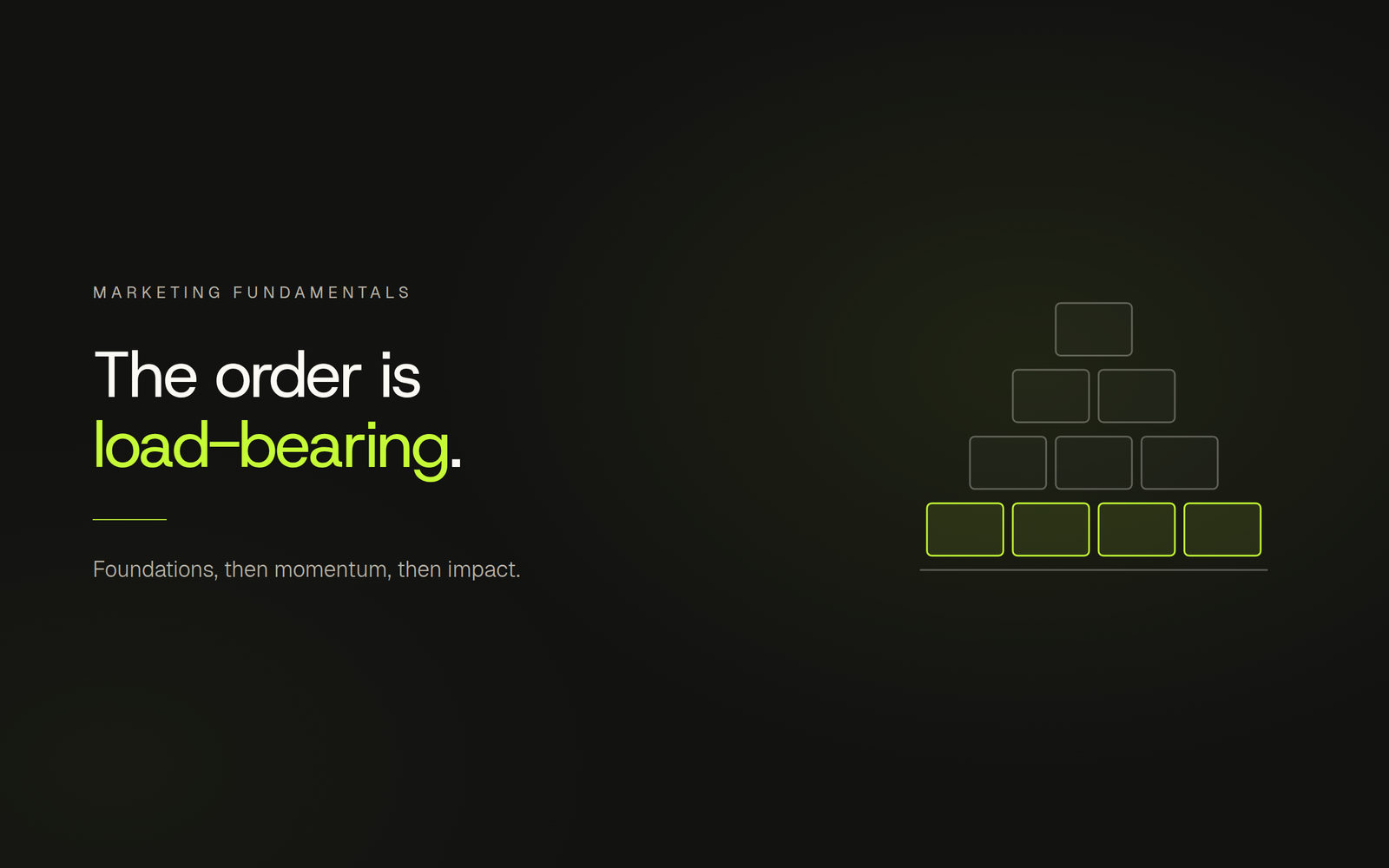
The marketing fundamentals are almost always taught as a list. Four P's, five C's, sometimes seven of something. Every one of those lists is real and worth knowing, and not one of them tells you what to build first.
That gap matters more than it sounds. A list of decisions can be worked through in any order. A marketing operation cannot, because each part of it rests on parts underneath it that either exist or do not. Build in the wrong order and the work still happens, it just stops compounding: the posts go out, the ads run, and nothing accumulates into something you own.
So this page does two jobs. It names the frameworks you probably came here for, then sets out the build order we work in, and why that order is load-bearing rather than a matter of taste.
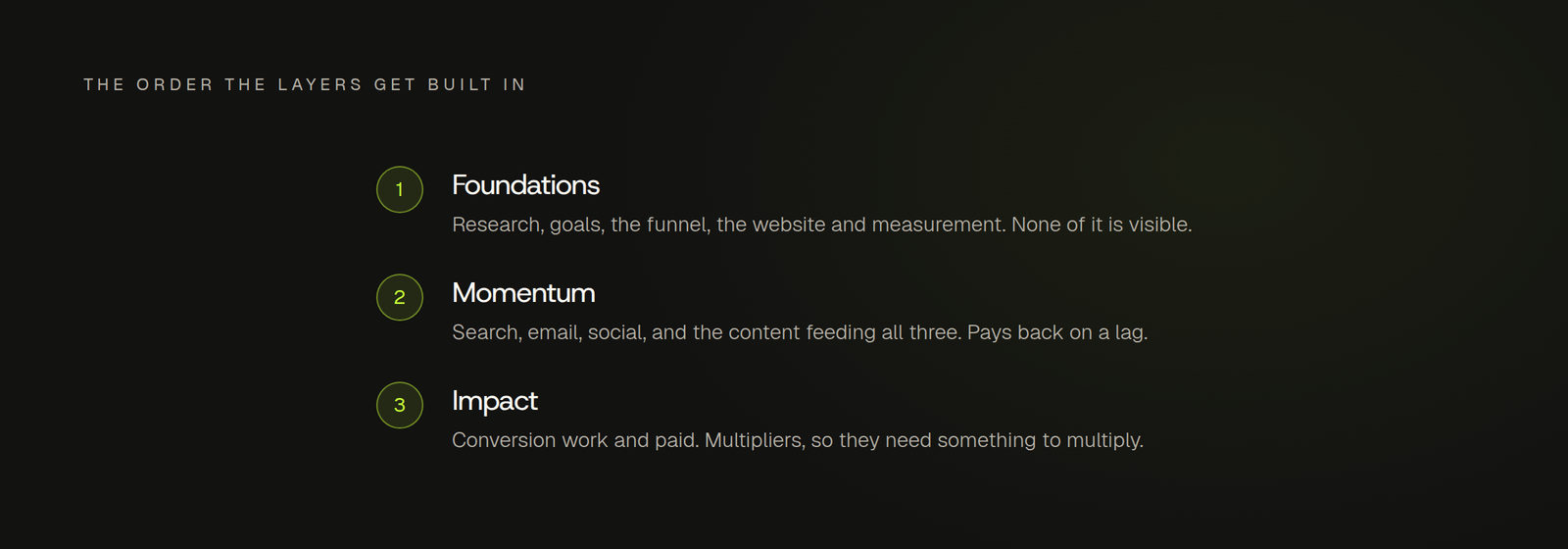
TL;DR. The marketing fundamentals are usually presented as the four P's, extended to seven for services, plus the five C's for situation analysis. None of those lists is a sequence. Build in three layers instead. Foundations first: research, goals, the funnel, the website and measurement. Then momentum: search, email, social, and the content that feeds all three. Then impact: conversion work and paid. Content is the cornerstone of the middle layer, which is why the foundations decide whether it compounds or leaks away.
What Are the Marketing Fundamentals?
Definition. Marketing fundamentals are the decisions and systems every other marketing activity depends on: who you serve, what you offer, at what price, through which channels, and how you know whether any of it worked. They are called fundamentals because they survive a change of tools. A new platform changes where you publish. It does not change whether you know who you are publishing for.
Three named frameworks account for most of what gets taught under this heading, and they are answering different questions.
- The four P's, the marketing mix. Product, price, place, promotion. A description of an offer and how it reaches a market.
- The seven P's. The same four, plus people, process and physical evidence, added because a service is produced in front of the customer rather than shipped to them.
- The five C's. Company, customers, competitors, collaborators, climate. A situation analysis, run before you decide anything about the offer.
Those three cover the ground. What they do not do is tell you in what sequence to stand them up, and that omission is where most of the wasted effort in marketing lives.
Why the Numbered Lists Do Not Agree
Search for the marketing fundamentals and the counts contradict each other. Five of this, seven of that, a rule of seven, a three-three-three rule. The contradiction is not sloppiness on anyone's part. It is that the lists describe different objects, and only some of them have a settled definition.
The four P's describe an offer. The five C's describe a market position at a point in time. The various sevens are either the services extension of the marketing mix or a heuristic someone coined and nobody sourced. We use the first two and ignore the rest, on the grounds that a framework you cannot trace is a framework you cannot argue with.
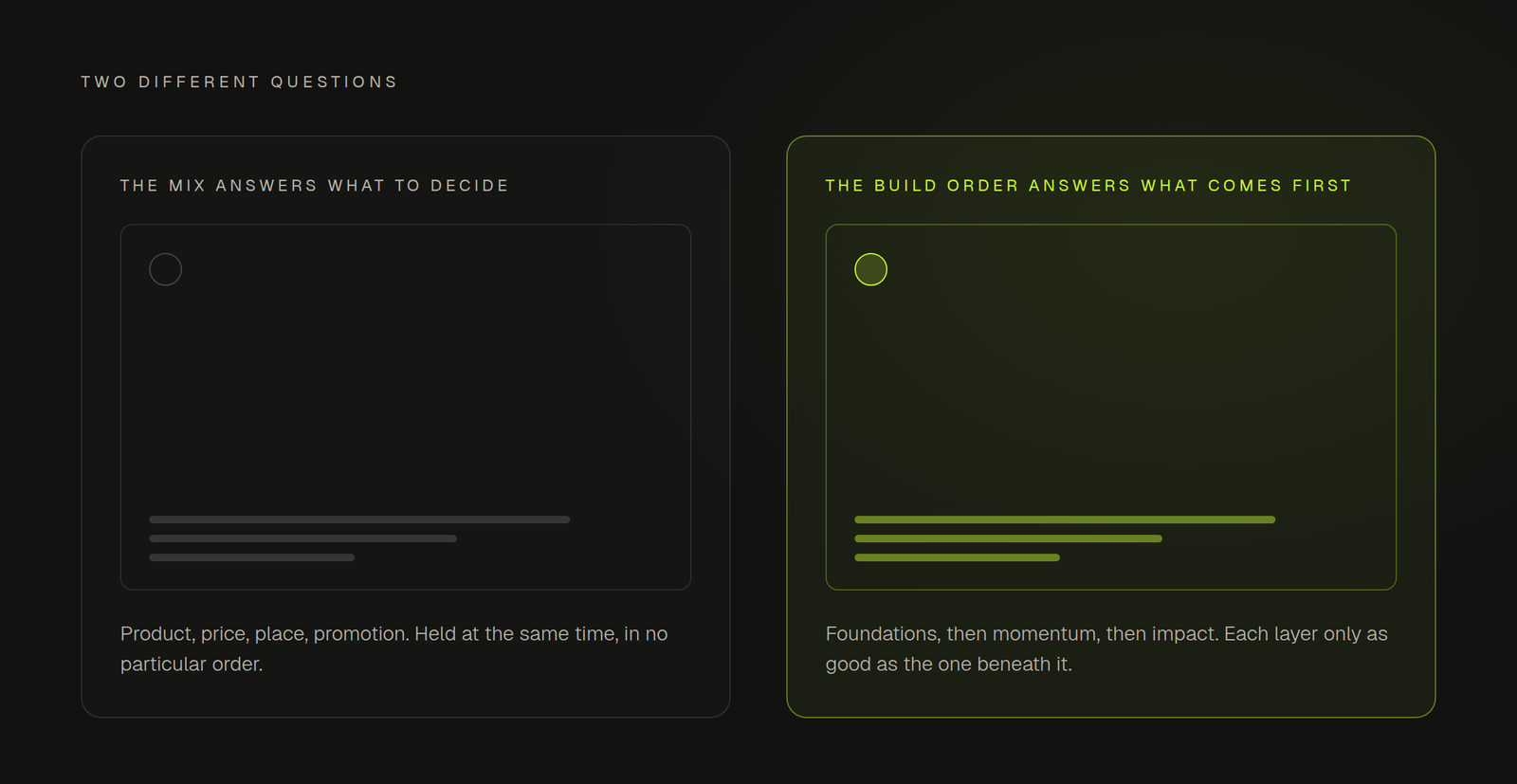
What none of them supplies is an order. A mix is a set of decisions held at the same time, which is exactly right for describing a strategy and no use at all for scheduling the work. That is the job a build order does, and it is the part you have to supply yourself.
The Three Layers of Marketing Fundamentals
We group the marketing fundamentals into three layers and build them in that order. Each layer is only as good as the one beneath it, which is the entire argument for the sequence.
Layer one: foundations
Research, goals, the funnel, the website and measurement. Research settles who you serve and what they already look for. Goals settle what counts as progress, which is what stops activity from being mistaken for progress. The funnel settles the difference between creating demand and capturing it, a distinction that decides both what you make and how you judge it. If you want that distinction properly, we go into it in the difference between demand generation and lead generation, and into the metrics each stage can honestly carry in marketing KPIs by funnel stage.
Then the two pieces that get skipped most often, because neither produces anything anyone can see: the website, as the one place every channel sends people, and measurement, as the only thing that can tell you which channel deserves the next hour. Measurement is the strict one. A tag reports from the day it is fitted and not before, so a measurement layer added after a campaign cannot tell you whether that campaign worked. Google's tag documentation describes server-side tagging as "a way to instrument your tags to measure user activity wherever it happens". Instrument is the right verb. It is something you fit before the run.
Cost is not the obstacle here, which is worth saying plainly because cost is usually the excuse. Microsoft's documentation for Clarity lists session recordings, heatmaps, and event and funnel tracking, and states that Clarity is "a free service forever". A behavioural measurement layer is a decision, not a budget line. Goals are the same kind of decision, and they are easier to set once you have seen a few written properly, which is what short and long term marketing goals examples is for.
Layer two: momentum
Search, email and social, roughly in order of how much patience each one asks for. This is the layer that builds reach you do not rent, and all of it pays back on a lag. Google's SEO documentation is candid about that lag: "Some changes might take effect in a few hours, others could take several months", and it suggests you wait a few weeks to assess whether your work had beneficial effects in search results.
Read that next to layer one and the reason for the order stops being abstract. A channel that pays back over months cannot be judged by a measurement layer you install next quarter, because by then the evidence of what worked has already passed. The lag is also why this layer punishes stop-start effort more than any other: consistency is not a virtue here, it is the mechanism.
Email is the one channel in this layer you own outright, so it is the one that survives a platform changing its mind. Social is the fastest to show life and the fastest to decay, which makes it a distribution surface rather than a foundation. Search sits in the middle and compounds hardest, provided somebody is feeding it.
Layer three: impact
Conversion work and paid. Both are multipliers, and a multiplier applied to nothing returns nothing. Conversion testing needs enough traffic to tell a real difference from noise, and layer two is what supplies that traffic. Paid needs an offer and a page that already convert, because paid does not repair a leaking page. It fills the page faster and charges you for the privilege.
Putting paid last is not a judgement about paid. It is the only position from which you can tell what it bought you, which is the same reason it goes last in the build and not last in importance.
Where Content Sits in the Order
Content is the cornerstone of layer two, and the reason is structural rather than fashionable. It is the only asset that serves search, email and social at the same time. One properly researched piece can answer a search query, carry a newsletter and supply a fortnight of posts. Nothing else in the marketing fundamentals has that property, which is why a content strategy belongs in the same conversation as the channels rather than downstream of them.
That position cuts both ways. Content inherits every weakness in layer one. Vague positioning produces posts that could carry any competitor's name without anyone noticing, which is the failure a documented brand and strategy capture exists to prevent. Missing measurement produces a library nobody can rank by performance, so the next brief is a guess dressed as a plan. Content does not substitute for the foundations. It magnifies them, and it magnifies whatever is actually there.
The practical consequence is that the content layer needs two things from further down the stack before it can compound: a documented voice and positioning so every piece is recognisable, and a way to see what performed so the next round is informed rather than invented. Given both, distribution across channels turns one piece of work into reach in several places. Missing either, it turns into volume.
Volume is the failure mode worth naming, because it looks like progress on every dashboard except the one that matters. A steady publishing operation is a system, not a schedule, an argument we make at length in the case for treating a content calendar as a system.
What Breaks When You Build Out of Order
Four failures, all common. Each one traces to a missing layer underneath rather than to bad execution on top, which is what makes the marketing fundamentals worth ordering rather than merely listing.
- Paid before a converting page. The spend is real, the traffic is real, and the page leaks it. Pausing the campaign looks like the fix, so the actual fault is never found.
- Content before positioning. The calendar fills, the posts are competent, and none of them is identifiable as yours. Output rises and recognition does not.
- Reporting before measurement. Everyone argues about numbers nobody instrumented. The meeting resolves by picking the most flattering chart.
- Channels before goals. Every channel looks like progress, because with no definition of progress there is nothing a channel can fail against.
A pattern we keep seeing is that none of these feel like ordering mistakes while they are happening. They feel like effort problems, so the response is more effort at the top of the stack, which is the one intervention that cannot work.
Frequently Asked Questions
What are the five fundamentals of marketing?
There is no single agreed list of five, which is why the answers you find disagree. The count depends on which framework is being quoted: four P's for the mix, seven for the services version, five C's for situation analysis. If you specifically want a set of five, the five C's is the one with a settled definition. What matters more than the count is that none of these lists is a sequence, so none of them answers the question of what to build first.
Is it 4 or 5 P's of marketing?
Classically four: product, price, place, promotion. A fifth, people, is commonly added, and the services version extends to seven with process and physical evidence. They are the same idea at different resolutions, and the choice between them matters far less than most articles imply, because all of them describe a set of decisions rather than an order for making them.
What are the 5 C's of marketing?
Company, customers, competitors, collaborators and climate. It is a situation analysis rather than a plan: it tells you what is true around you before you commit to an offer or a channel. In the build order set out above it belongs in layer one of the marketing fundamentals, alongside research and goals, well before anything gets published.
Conclusion: Marketing Fundamentals Are an Order, Not a List
The frameworks are not wrong. They are simply answering a different question from the one an operator has on Monday morning, which is not what the marketing fundamentals are but which of them to build next. Foundations, then momentum, then impact. Research, goals, funnel, website and measurement before channels. Channels before multipliers.
Build in that order and content compounds, because every piece lands on positioning that is already decided and measurement that is already watching. Build out of order and the same content leaks away, and the shortfall reads as a content problem when it was a sequencing problem all along.
Sempyo is the content layer built on that assumption: a documented Blueprint first, then finished posts week after week in your own voice. It is pre-launch, so there are no customer results to quote, and the honest version of the pitch is a mechanism rather than a number. If the foundations are in place and the middle layer is what keeps stalling, it is worth a look.