An AI-ready brand voice guide is a structured, operational document that gives clear, actionable rules and examples for AI content tools. This makes sure you get consistent, on-brand output at scale. It really goes beyond just abstract ideas, moving into concrete instructions that AI can actually understand and use effectively across lots of different content types and platforms.
TL;DR: All that traditional, abstract brand voice stuff just doesn't work anymore with AI-generated content. This guide shows you how to build a future-proof brand voice by designing structured, modular, and example-rich assets that AI can totally get and apply. By zeroing in on operational rules and super specific directions, businesses can make sure their content is consistent and on-brand, keeping their brand strong even with all the automation.
The AI Content Deluge: Why Traditional Brand Voice Guides Fail
The content world has shifted completely, right? What used to be this human-led, manual process of writing, editing, and then publishing is now pretty much dominated by AI. It can pump out content at a scale that's just, well, unimaginable. Your business is probably already feeling that pressure to keep up, to be everywhere your audience is scrolling. But scaling content creation with AI brings in a HUGE risk: brand dilution.
Honestly, your run-of-the-mill brand voice guide, the one packed with poetic descriptions of your brand's personality and high-level principles? It's just not built for this new era. An AI can't really make sense of "we are innovative and bold" in any consistent way. It needs explicit instructions, not vague feelings. Without a clear, operational framework, AI models just fall back on their generic, lifeless training data, creating content that sounds like everyone and no one. That's the quickest way to just vanish in a crowded market.
The thing is, those old documents were made for human writers who could fill in the blanks and understand context. They were never meant to be machine-readable instructions. And what happens? You end up with a content engine just running wild, without any direction. You get stuff that's grammatically fine but completely off-tone, missing that unique spark that makes your brand unmistakably yours. This kind of inconsistency slowly eats away at the trust you've worked so hard for. Experts at places like Sprinklr and Adobe agree: modern brand voice guidelines NEED to be short, specific, and easy to use, not some long manifesto.
What is an AI-Ready Brand Voice Guide?
An AI-ready brand voice guide isn't some philosophical paper; it's a technical blueprint. It takes your brand’s personality and turns it into a set of explicit, machine-readable rules that an AI can follow perfectly. Instead of saying your voice is “friendly,” it gives concrete directions like “Always use contractions (e.g., you’re, it’s)” or “Address the reader directly as ‘you’.” This approach just kills all the ambiguity and guesswork in content generation.
What is an AI-ready brand voice guide? It’s a structured asset designed specifically for AI. It contains specific rules, formatting guidelines, and a whole library of 'do' and 'don't' examples. It focuses on measurable characteristics and operational commands more than abstract descriptions, making sure every piece of AI-generated content aligns perfectly with your established brand identity.
This modern guide acts as the strategic foundation for all automated content creation. It guarantees that whether the AI is drafting a social media post, an email campaign, or a blog article, the output keeps a consistent tone, style, and persona. It’s the difference between just spitting out random content and really orchestrating strategic, on-brand communication on autopilot.
Pillars of a Future-Proof Brand Voice
Building a brand voice that actually lasts and works well for the AI age starts with some serious simplification. We're talking about distilling your brand's entire personality down to its absolute most critical, non-negotiable pieces. Seriously, forget the huge lists of adjectives and vague descriptors. The goal here is to create a super focused, operational core that any system can understand and copy.
Industry best practices all point to a clear formula. Adobe’s own performance marketing guidelines recommend you focus on just 3-6 core voice attributes. This small number stops the AI from getting totally overwhelmed with conflicting instructions and lets us build really deep, specific guidance around each attribute. For example, instead of just saying your brand is “Helpful,” you actually define what “Helpful” means in the real world:
-
Do: Use numbered lists to break down complex steps.
-
Do: Define technical terms in simple language.
-
Don't: Use industry jargon without explanation.
-
Don't: Assume the reader has prior knowledge of the topic.
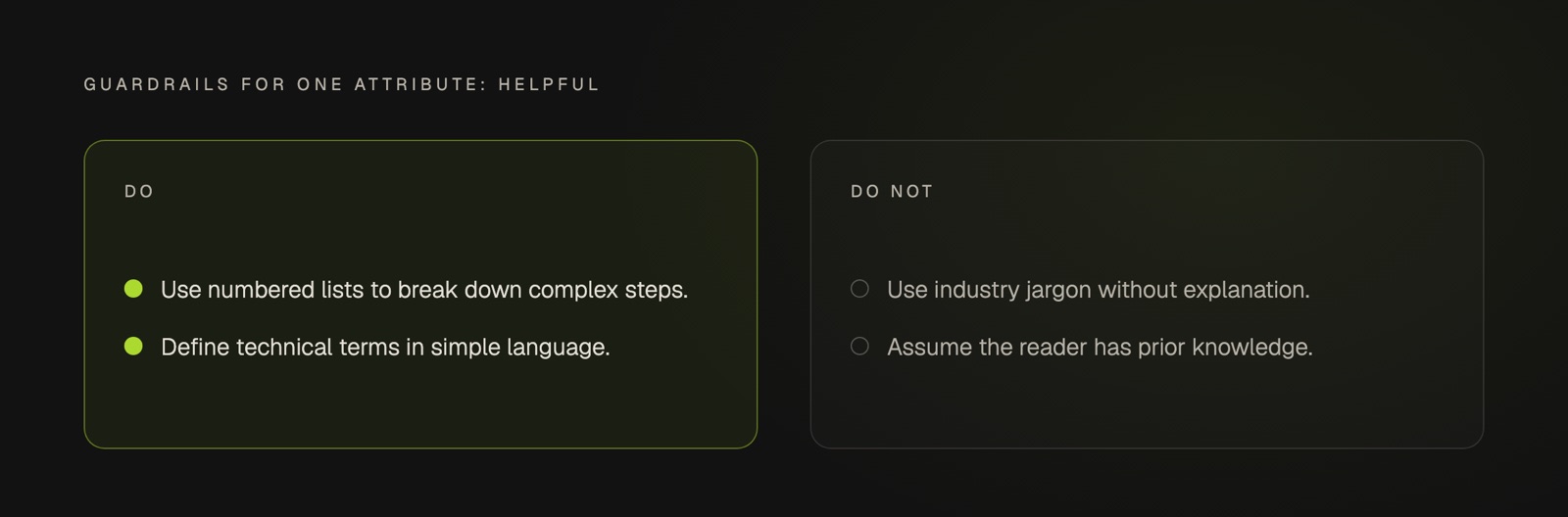
This level of specificity is what makes a brand voice guide *truly* functional. Each attribute becomes a key support for your content strategy, complete with positive and negative examples that act as clear guardrails. This setup changes your voice from some abstract idea into a concrete set of commands. Your content isn't just on-brand by accident anymore; it's on-brand by design, every single time. That's a MASSIVE difference.
How to create a brand voice guide for AI and Automation
Moving from a traditional document to an AI-ready asset means taking a strategic, step-by-step approach. It’s about tearing down and rebuilding, turning your abstract brand identity into a logical system. Here’s how you can start to convert your existing brand voice guide for AI.
-
Define 3-6 Core Attributes: Like we said, this is your foundation. Pick attributes that are distinct and defensible. Things like "Straight-talking," "Optimistic," or "Authoritative" are good starts. These are the main supports of your voice.
-
Develop Rule-Based Directives: For each attribute, make a list of explicit 'Do' and 'Don't' rules. These are the direct commands the AI will follow. Be super specific. “Use active voice” is a rule. “Sound confident” is not.
-
Build a 'Before-and-After' Library: This is one of the most powerful ways to train an AI. Creating a library of "generic draft → brand-approved rewrite" examples gives it concrete context. Show how a basic AI output for an email or social post gets transformed into something that's totally yours. These brand voice guide examples serve as both training data and a quality benchmark. We've actually put together some effective brand voice guide examples built for AI to show you just how it's done.
-
Embrace Modular Design: A single, giant document just isn't efficient. Adopt a modular brand voice system by splitting up your guidance into separate files. You might have one module for your overall brand tone, another for specific product marketing stuff, and a third for social media engagement. This lets an automation platform only grab the relevant info for a particular task, making the whole process faster and more accurate.
The market demand for this kind of capability is just exploding, by the way. Platforms like Jasper have seen users create over 69,500 unique brand voices, which tells us there’s a clear need for businesses to really get their identity working at scale. A structured, modular, and example-rich AI brand voice guide isn’t a "nice-to-have" anymore-it’s the absolute central asset for any business that’s serious about keeping its brand strong in an automated world.
Translating Abstract Principles into Actionable AI Directives
The main hurdle in making a brand voice AI-ready is taking those subjective feelings and turning them into objective commands. Your team likely gets your brand's "vibe" intuitively, but an AI needs a dictionary to translate it. And this translation process? That's where you build the real power of your brand voice guide.
Let's take something common but abstract: "Friendly." What does that *actually* mean when we're writing? An AI-ready guide would break it down like this:
-
Attribute: Friendly
-
Rule 1: Use contractions (e.g., "you'll," "we're") to create a conversational tone.
-
Rule 2: Address the reader directly as "you" to build a personal connection.
-
Rule 3: Avoid overly formal vocabulary (e.g., use "use" instead of "utilize").
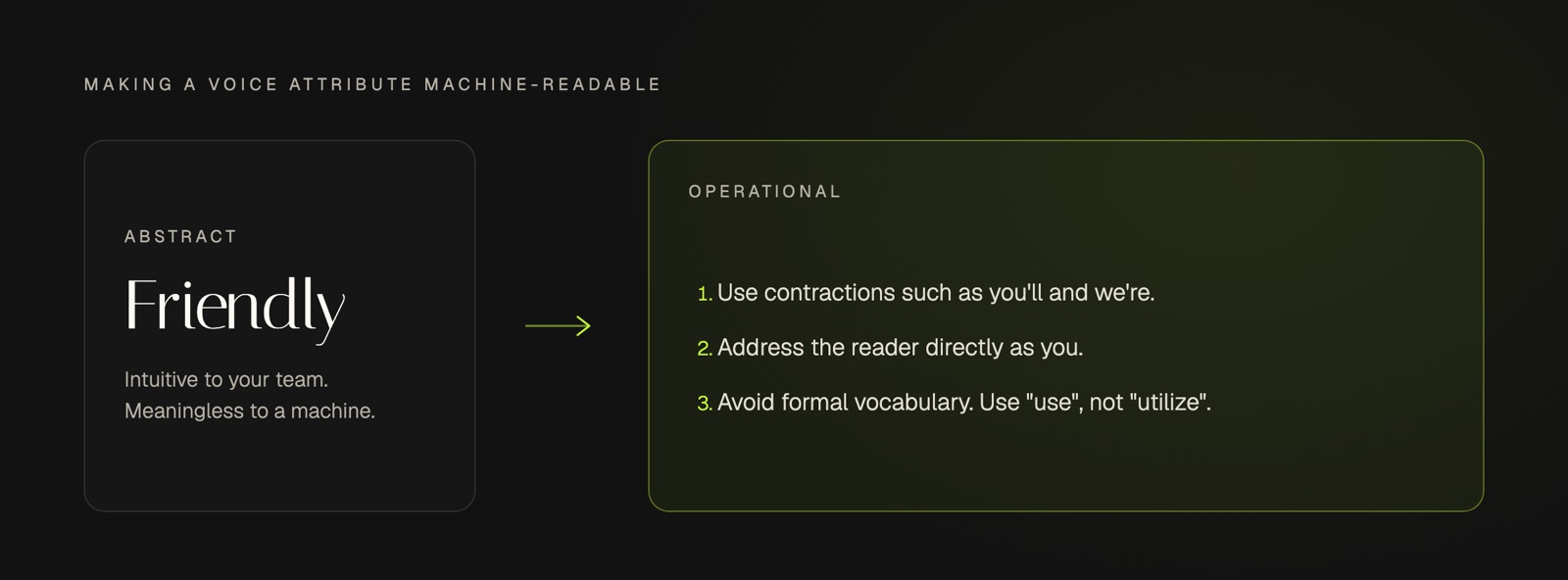
This process demystifies your voice and makes it copyable. By creating these explicit connections, you address worries that AI-driven content loses creativity. Actually, a strong brand voice guide empowers the AI to be creative within a defined framework, making sure every piece of content reinforces your brand identity. And if you organize these rules even further with metadata, maybe tagging them by platform (blog vs. social) or intent (sales vs. support), it adds another layer of precision for those really sophisticated automation systems.
Integrating Your AI-Ready Voice Guide with Automation Platforms
An AI-ready brand voice guide is only as good as the system that actually uses it. Once you've created it, this structured document becomes the "brain" for advanced content automation platforms. This is where the magic really happens, turning your strategic blueprint into actual results, at scale.
Platforms like Sempyo are built specifically for this. Our system takes in your finished brand voice guide, what we call Your Blueprint™. This isn't just uploading a file; it's a deep integration where every rule, example, and attribute becomes an operational command inside our content generation engine. Your Blueprint™ makes sure that from the moment you decide to generate campaigns, every single piece of content-from a LinkedIn post to a detailed whitepaper-is created with your unique voice completely ingrained.
Your voice isn't just something added on during editing. It's the genetic code that all your content comes from. Period.
The benefits go way beyond just the first draft. The best automation platforms create a continuous feedback loop. The system looks at how the content it created performs-what gets engagement, what drives conversions-and then feeds that intelligence back into the model. This means your content engine gets smarter over time. It learns which applications of your voice resonate most with your audience and adjusts its output accordingly. This is how you build real momentum. Your authority just grows week after week, with a consistent presence that is always on-brand and always getting better.
Measuring Brand Consistency in the Age of AI
With AI cranking out content at scale, how do we make sure it stays on-brand? The answer is a mix of automated analysis and smart human oversight. While it’s just not practical to manually review every single sentence, we can set up systems to monitor how well the brand voice is being followed.
Tools can be set up to scan for specific keywords, phrases, and even stylistic patterns that are defined in your . For example, you can track if forbidden jargon is being used or check for the presence of your main messaging pillars. These metrics give you a bird's-eye view of consistency across thousands of assets. But honestly, technology alone isn't quite enough. Regular audits, where a person reviews a sample of AI-generated content against the guide, are crucial for catching nuance and finding areas where the guide itself needs tweaking. This constant cycle of generating, measuring, and refining means your brand voice not only stays consistent but also gets smarter over time.
Key Takeaways for AI-Powered Brand Voice
-
Structured guides are essential for scaling content with AI without losing your brand's identity.
-
Make your voice operational with clear 'Do' and 'Don't' rules, plus concrete examples.
-
Focus on only 3-6 core voice attributes to keep things clear and prevent AI confusion.
-
A modular design lets AI grab just the context it needs for a specific task.
-
With a proper , you can confidently automate content campaigns that are always on-brand.
-
Continuous feedback from performance data refines consistency and impact over time.
Frequently Asked Questions
What are the common pitfalls of traditional brand voice guides?
Traditional brand voice guides are often too abstract, relying on subjective descriptions instead of concrete rules. This makes them hard for AI tools to interpret and apply consistently, leading to generic or off-brand content that just dilutes brand identity and erodes trust.
How Many Brand Voice Attributes Should a Company Focus
Experts recommend focusing on 3-6 core brand voice attributes . This limited number allows for specific, actionable guidance that AI tools can easily use, preventing overwhelming complexity while still keeping your brand communication and messaging distinct.
Why is a modular brand voice system beneficial for AI?
A modular brand voice system separates guidance into different documents for specific contexts (like product marketing versus general branding). This lets AI agents ingest only the information that's directly relevant for a campaign, making content automation more targeted and efficient.
The Bottom Line
The era of AI content generation isn't some far-off sci-fi fantasy-it's what's happening right now in 2026. Businesses that are clinging to those old, abstract brand voice documents are just going to watch their identity disappear into all the digital noise. The ones that really succeed will be those who treat their brand voice as a core technological asset: structured, modular, and built for automation.
By creating an AI-ready , you’re not just managing risk; you’re building a Scale Multiplier. You’re putting a system in place that lets you own your niche, generate strategic campaigns on autopilot, and build a reputation that precedes you. This is how you make sure that no matter how much content you produce, every single word is unmistakably yours.
Ready to future-proof your brand voice and unlock scalable, on-brand content generation? Explore how Sempyo’s Your Blueprint™ can transform your content strategy.