A calendar that holds only dates will tell you a post is due on Tuesday and nothing about who is writing it, who is designing it, or which version of it goes to which channel. That gap is where the week goes. Dates are the cheapest thing in a calendar to get right, and the first thing teams mistake for the whole job.
The calendar most social media managers inherit is a grid of dates with a topic in each cell. It survives about three weeks. An editorial calendar social media teams actually keep looks different: it tracks state rather than timing alone, and it holds one row per asset instead of one row per idea. If the strategic question is still open, the cluster anchor covers why a content calendar is a system rather than a schedule. This post is about the operational layer underneath it.
TL;DR: A date tells you when something is due. A workflow tells you what has to happen before it can be. Give every row a state, an owner for that state, a named channel variant and the finished asset it depends on, and the calendar stops being a wish list.
The Dates Were Never the Hard Part
Picking Tuesday is a five second decision. Everything that makes Tuesday possible is not: the angle, the draft, the design, the crop for each placement, the caption written to that platform's conventions, the alt text, the approval, the link. A date-only grid makes all of that invisible, so the work lands as a surprise on Monday night, every week, in a slightly different shape.
An editorial calendar is the operating record of what is being published, by whom, in what state, and on which channel. A schedule answers when. An editorial calendar answers where each piece currently sits and what has to happen before it moves. Only one of those two things can be handed to someone else halfway through a week, which is the whole practical difference between them.
What an Editorial Calendar Social Media Teams Keep Has to Carry
The anchor covers the strategic fields a row should hold, the audience it is for and the outcome it is meant to produce. These are the production fields, and they are what make a calendar operable rather than decorative.
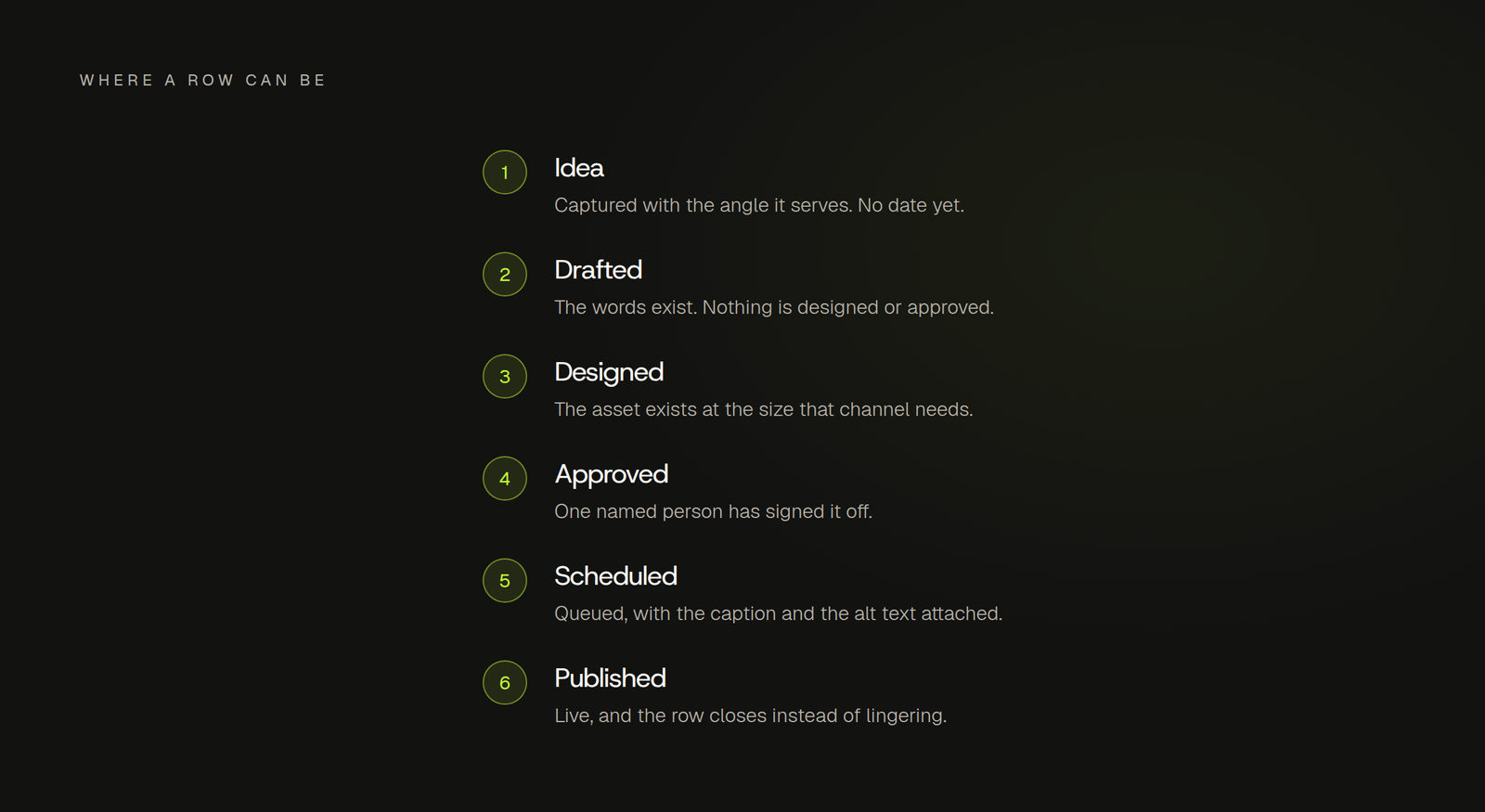
- State. Idea, drafted, designed, approved, scheduled, published. Six words, one column. A row with no state is a row nobody else can pick up.
- Owner of the current state. Not the owner of the post, the person who has to move it out of the state it is in right now. Those are often different people, and the second one is the one who is actually blocked.
- Channel variant. Named explicitly, because one idea rarely publishes as one asset.
- The asset it depends on. A link to the real file or frame. If the row cannot point at the thing, the thing does not exist yet.
There is a simple test for whether a column has earned its place: if nobody would behave differently when it changes, delete it. Engagement targets copied into a planning row fail that test. A state column passes, because a row sitting in "designed" for four days is a visible problem, while a row labelled "week 12" is just a label. The reason an editorial calendar social media teams share tends to rot is almost never the tool. It is that no column in it describes work.
One Idea Is Not One Post
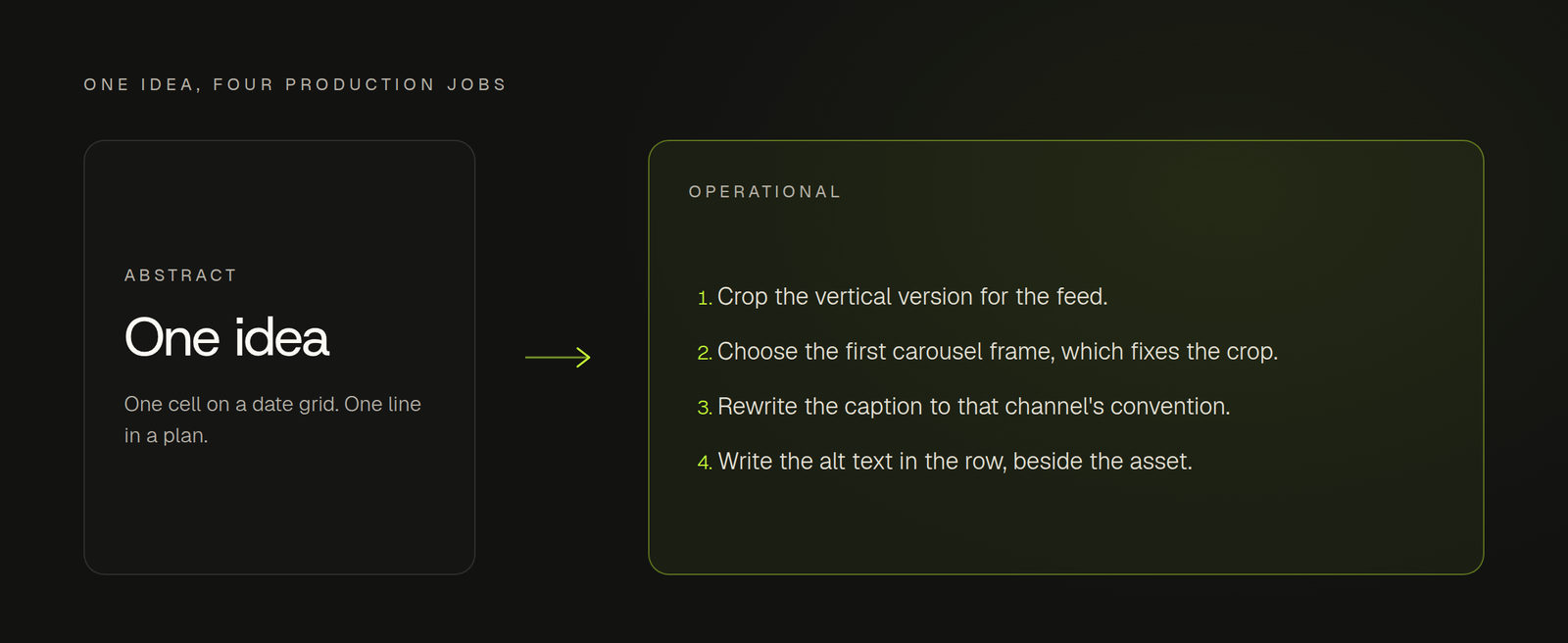
This is where date-shaped calendars break first. A single idea becomes several channel-native assets, each with its own production step, and each of those steps has to be scheduled rather than assumed. The vertical crop, the square crop, the caption rewritten to a different convention and the alt text are four jobs, not one job with four outputs.
The constraints are specific, and they are published. Meta's content publishing documentation states that carousels are limited to 10 images, videos, or a mix of the two, and that carousel images are all cropped based on the first image in the carousel, with the default being a 1:1 aspect ratio. That is a design decision with a deadline attached: the first frame fixes the crop for everything behind it, so it has to be chosen before the set is built, not repaired afterwards.
Alt text is the step most often missing from a row, because nobody owns it. The W3C's guidance on non-text content puts the standard plainly: all non-text content that is presented to the user has a text alternative that serves the equivalent purpose. Written at publish time, it is an afterthought typed by whoever is holding the phone. Written in the row next to the asset, it takes a minute and it is accurate. Our approach to repurposing treats every variant as its own deliverable for the same reason.
Build an Editorial Calendar Social Media Teams Actually Maintain
Start from the states, not the weeks. Write the six states down, agree what finished means for each one, and only then lay dates over the top. Built the other way around, a calendar quietly encodes the fantasy that a post arrives fully formed on its publish date.
Then keep it small enough to survive a bad week. One row per asset. One owner per state. One standing slot in the week where rows move and stale ones are killed rather than rolled forward. A row rolled forward twice is a signal that the idea is not really wanted, and a calendar that never deletes anything turns into a guilt list that people stop opening.
Distribution belongs in the same record. If a piece is going to three places, the calendar shows three rows with three owners, which is also how you discover that the third one never had an owner. That is the practical case for treating distribution as part of the plan rather than as the last step on publish day.
Frequently Asked Questions
What is an example of an editorial calendar?
A workable one is a single table where each row is one asset, with columns for state, owner, channel, publish date and a link to the finished file. A week of it might read: carousel, designed, owned by Sam, Instagram, Tuesday, file attached. The same idea appears again on its own row for the written version, with a different owner and a different state. It looks less tidy than a month grid and it tells you far more.
What is the best content calendar for social media?
The one your team updates without being reminded. A shared table that is current beats a well-designed board that is three weeks stale, and the second one is more common because elaborate boards cost more to maintain than the work they track. Choose for how little effort it takes to move a row, then check after a month whether anyone is still moving them.
Is there a free template for a social media calendar?
Plenty, and the template is rarely the real constraint. A template hands you columns. It cannot hand you the agreement about who moves a row out of drafted, which is the part that fails. Take a free one, add a state column and an owner column, and delete every column nobody acts on. The editorial calendar social media teams abandon is usually the one nobody agreed to own in the first place.
Conclusion
A calendar earns its keep when it answers what happens next, not just when. An editorial calendar social media work can actually run on carries states, owners, channel variants and real assets, and it stays small enough that keeping it current is cheaper than ignoring it. If holding that together every week is the part that keeps slipping, it is a systems problem rather than a discipline problem, and it is worth a look at how the Blueprint fixes voice and format before the week starts.