
An editorial calendar is the single record of what gets published, when, on which channel, and by whom. The ones that last are small. Most abandoned calendars were not badly designed, they were designed to need more upkeep than the team could afford every week.
The failure is rarely dramatic. One column stops being filled in, then another, and within a month the calendar describes a plan nobody is following. The publishing carries on. The record of it quietly stops matching reality, and once it stops matching, nobody opens it.
TL;DR: Complexity is the usual reason editorial calendars get abandoned. Every extra field is a cost paid again every week, out of the same hours as the writing and the design. Build the year from a few recurring themes instead of fifty-two separate decisions, give each entry a review date so that going stale becomes a visible state, and keep the row short enough that updating it is never the hard part.
Why Elaborate Editorial Calendars Get Abandoned
Building a calendar is a one-off cost. Maintaining one is a recurring cost, and on the afternoon you build it the two are easy to confuse. A grid with a dozen columns is satisfying to set up on a quiet day and expensive to keep honest on a busy one.
What is an editorial calendar? An editorial calendar is a working record of planned content: what each piece is about, which channel it belongs to, when it is due, and who owns it. It differs from a publishing schedule because it carries the decisions behind each item rather than only the dates, which is why it has to be maintained instead of filled in once.
That weekly maintenance comes out of the same hours as the writing, the design and the publishing. When those hours get tight the calendar loses, because nothing visible breaks when it goes stale. The posts still go out. Only the record rots, and a stale record is worse than none, because it still has to be read before it can be ignored. Which decisions a calendar has to carry is the subject of the cluster anchor on why a content calendar is a system rather than a schedule.
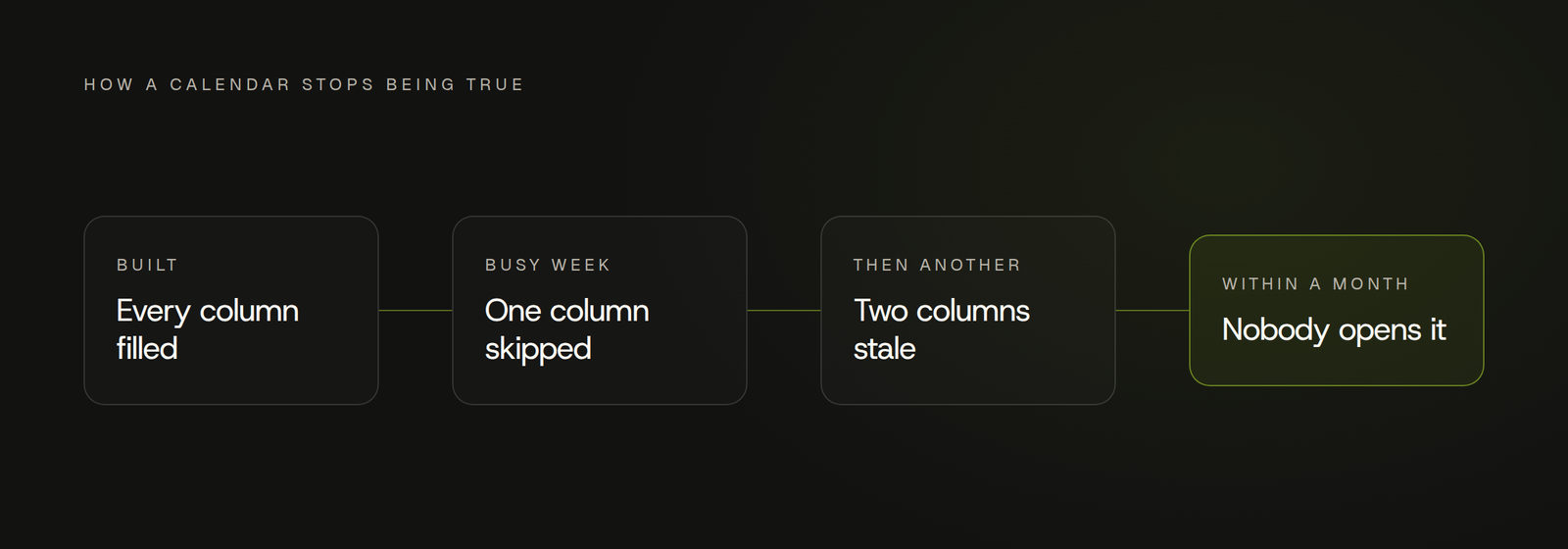
A calendar you maintain badly is not a smaller version of one you maintain well. It is a document that lies to you.
Build the Year From a Few Recurring Themes
Fifty-two unique topics is fifty-two decisions. A small set of themes that repeat is four or five decisions, made once, and it gives you a default answer to the question that stalls most weeks: what goes out on Thursday.
Michigan State University's communications team gives similar advice in its own editorial calendar guidance, suggesting you set aside a day or more once a year to plan out the large themes and projects, and then fill in the gaps of your calendar with smaller content. The order is the useful part. Themes first, then the individual pieces, because themes are what survives a busy month.
Good themes come from positioning rather than from the calendar itself. They are the handful of things you want to be known for, which is the same material a Blueprint captures before anything gets written. A theme earns its place if you can write against it a dozen times without repeating yourself, and if a reader would recognise it as yours.
Give Every Entry a Review Date
Maintenance fails when it depends on somebody remembering. It works when the system can tell you what is overdue. The UK government's publishing guidance does exactly that, tracking whether the content is overdue for a review, based on the review date that someone set when they last updated the content.
That turns a vague intention into a field. The date is set by the person who last touched the item, so the judgment gets made while the context is fresh rather than months later by whoever happens to open the file. Anything past its date is then a visible state rather than a nagging feeling, and it can be sorted, filtered and worked through in one sitting.
Pair it with a signal worth reviewing against, so the review has something to decide with. Which numbers deserve that role is a separate question, and what you do with the results is where most of the value sits.
What a Simple Editorial Calendar Looks Like in Practice
It has deliberately fewer fields than feels comfortable. A workable row carries:
- The theme it belongs to, chosen from your short list.
- The channel, because the format follows from it.
- The publish date, with the owner's name beside it.
- A review date, set when the entry was last touched.
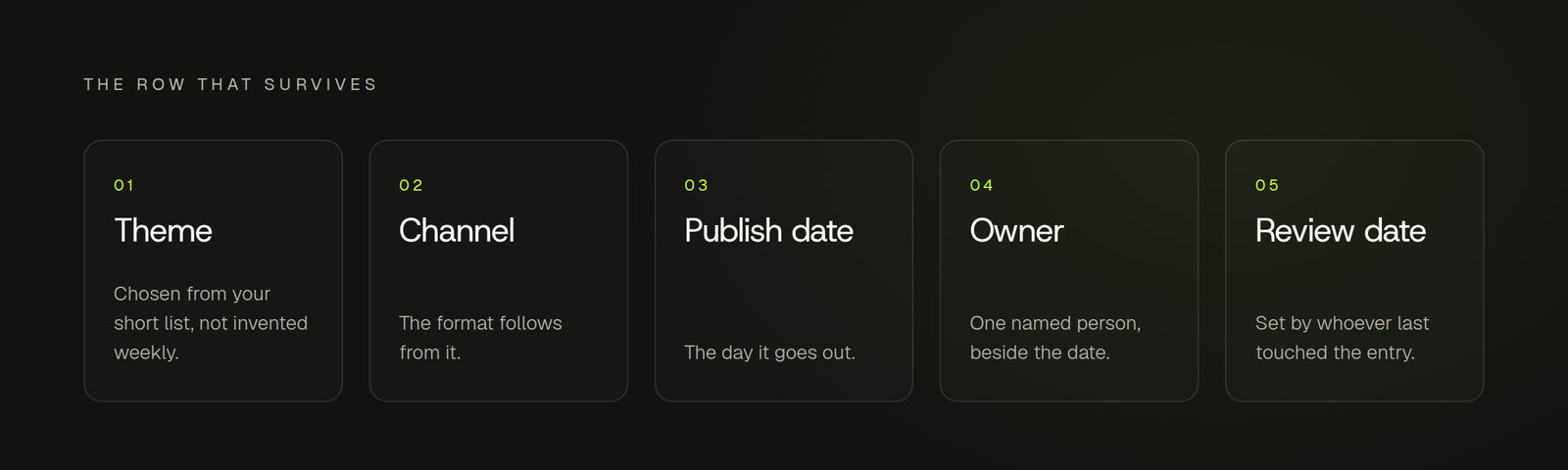
Anything else earns its column by being read at least as often as it is written. A status field usually passes that test. A field for estimated effort usually does not, because it gets filled in once and consulted never.
Keep the tool boring. The same university guidance is explicit that there is no wrong way to build one and that it does not have to cost you anything, and a shared spreadsheet that actually gets updated beats a specialist system that does not.
Key Takeaways
- Calendars are abandoned over upkeep cost, not over bad design.
- Maintenance is paid weekly, out of the same hours as the work itself.
- A few recurring themes replace fifty-two separate decisions.
- A review date turns going stale into a visible state.
- Every column should be read as often as it is written.
Frequently Asked Questions
What does an editorial calendar do?
It holds the decisions behind your publishing in one place: the theme each piece serves, the channel it is for, when it is due, and who owns it. Its job is to make the next piece of work obvious, so a week starts with production rather than with a discussion about what to make.
What is the difference between an editorial calendar and a content calendar?
In everyday use the two terms are interchangeable. Where teams do separate them, the editorial view covers what is being made and why, including themes, owners and deadlines, while the other is the narrower publishing view of what goes out on which day. One is the plan, the other is the timetable.
What are the different types of marketing calendars?
Most teams keep some mix of an editorial plan, a social publishing schedule, a campaign calendar tied to launches, and a promotional one for offers and seasonal dates. They overlap heavily, and maintaining four separate versions is usually how upkeep becomes unaffordable. A single calendar with a theme field is easier to hold.
The Bottom Line
The best editorial calendar is the one still being updated in March. That is a design constraint rather than a motivational point: every field you add is a promise to maintain it, and the honest test is whether the person who has to update it on a bad week still does. Start with a few themes, a review date, and fewer columns than feel right.
If holding that rhythm is the part that keeps slipping, having the work produced and published for you is worth a look. Either way the point is the one we build for: good businesses should not go quiet because the week got busy.