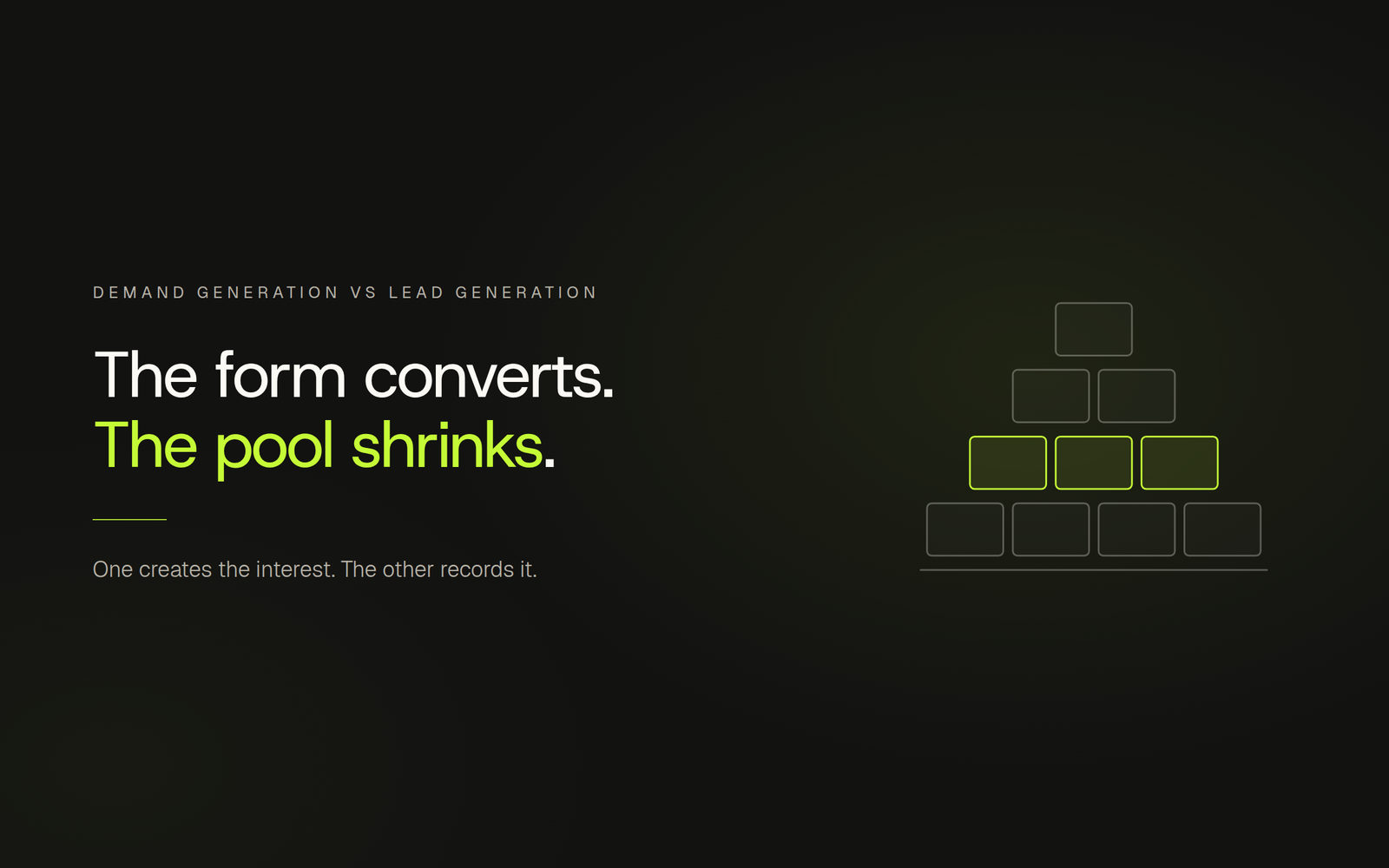
Demand generation and lead generation are not two labels for the same funnel work. One creates interest that did not exist yet. The other turns interest that already exists into a contact record you have permission to follow up.
They also report on different clocks. A form submission is countable the day it happens; the work that made someone want to fill it in may have started months earlier and leaves no row anywhere. So demand generation vs lead generation is less a question of vocabulary than of which metric you let make budget decisions.
TL;DR. Demand generation creates interest. Lead generation captures it as an identified contact. Your own tools already draw the line: a subscriber and a lead are separate stages. The common failure is judging demand work by lead counts, because capture reports this week and demand pays back over quarters.
Demand Generation vs Lead Generation: Two Jobs, One Funnel
Definition. Demand generation is the work that makes a market aware it has a problem worth solving and that you are a credible answer to it: content, distribution, search presence, and the reputation that makes someone type your name instead of a category. Lead generation converts an already interested person into an identified contact you are allowed to reach: a form, a gated asset, a booking page, an opt-in, and the segmentation that follows.
The clearest test is what each produces. Demand work produces a change in behaviour across people you cannot name. Capture produces a row with a timestamp and an address you can write to. Different objects, so they cannot honestly share a target.
Both are settled in the foundations layer of the build order we put the marketing fundamentals in, before any channel is stood up. Demand with no capture loses the interest it earned to whoever asks for the meeting first. Capture with no demand means polishing a form that fewer people reach.
Where the Split Already Exists in Your Tools
The software most small teams already run encodes the distinction. HubSpot's lifecycle stages put a subscriber before a lead and define the two differently. A subscriber is "a contact that has opted in to hear more from you by signing up for your blog or newsletter", while a lead is "a contact or company that has converted on your website or through some other interaction with your organization beyond a subscription sign up".
The earlier stage is defined by attention given; the stage called lead is defined by an action taken beyond attention. A CRM draws that line because the two populations need different handling.
The ad platforms say it from the other direction. Google's documentation for lead form assets describes them as a way to "capture interest when potential customers are searching, discovering, or watching relevant content". Capture is the accurate verb, and it presumes something is already there to capture.
What Breaks When One Number Judges Both
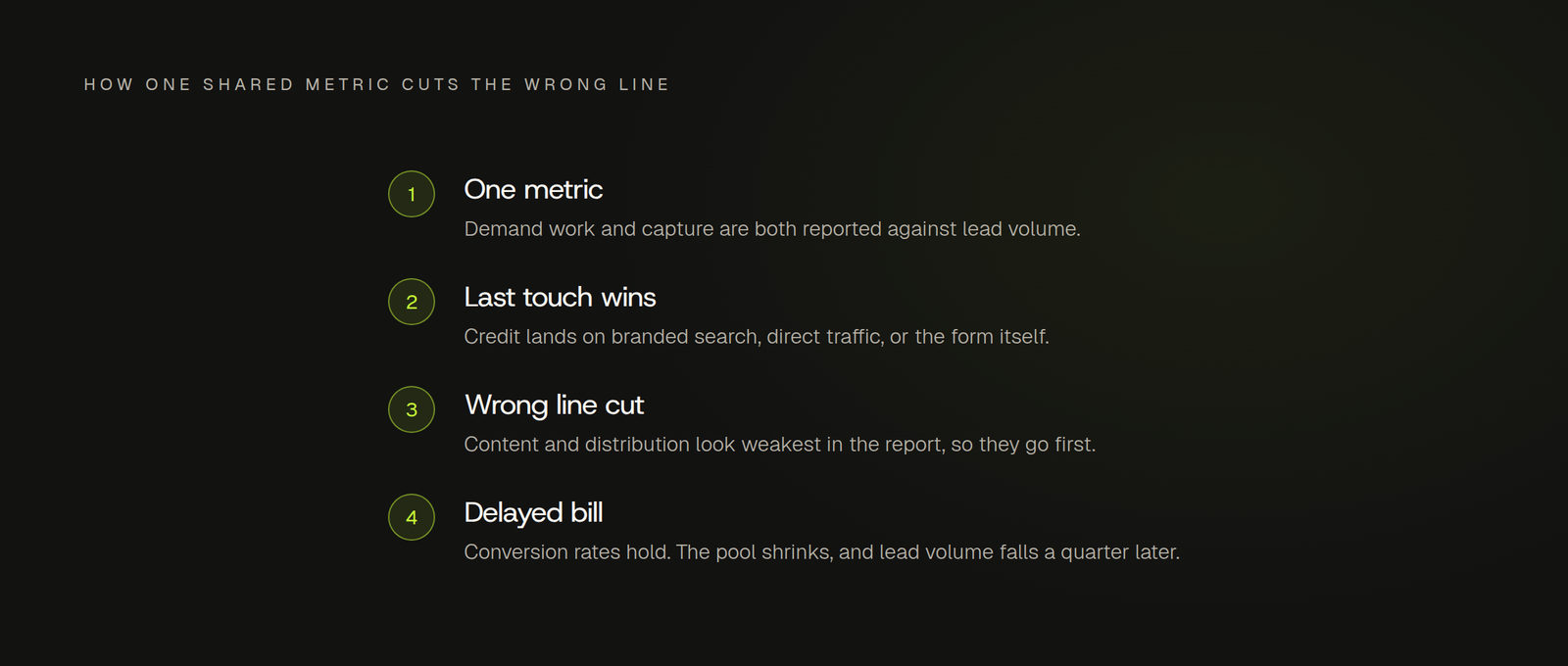
The failure runs in a predictable sequence. Demand work gets reported against lead volume, where it shows up badly, because the credit lands on whatever came last in the path: branded search, direct traffic, or the form itself. The content and distribution line then looks like the weakest line in the report, so it is cut first.
Nothing appears to break, which is what makes the decision expensive. Conversion rates hold, because the people still arriving already knew you. The pool they are drawn from shrinks quietly for a quarter or two, and then lead volume falls with nothing in the same period to explain it. Judging demand generation vs lead generation against one shared metric is how that gets decided with a straight face.
The inverse mistake is cheaper but real: a page many people see and few act on is a page problem, and more traffic will not fix it.
How to Measure Each Side Honestly
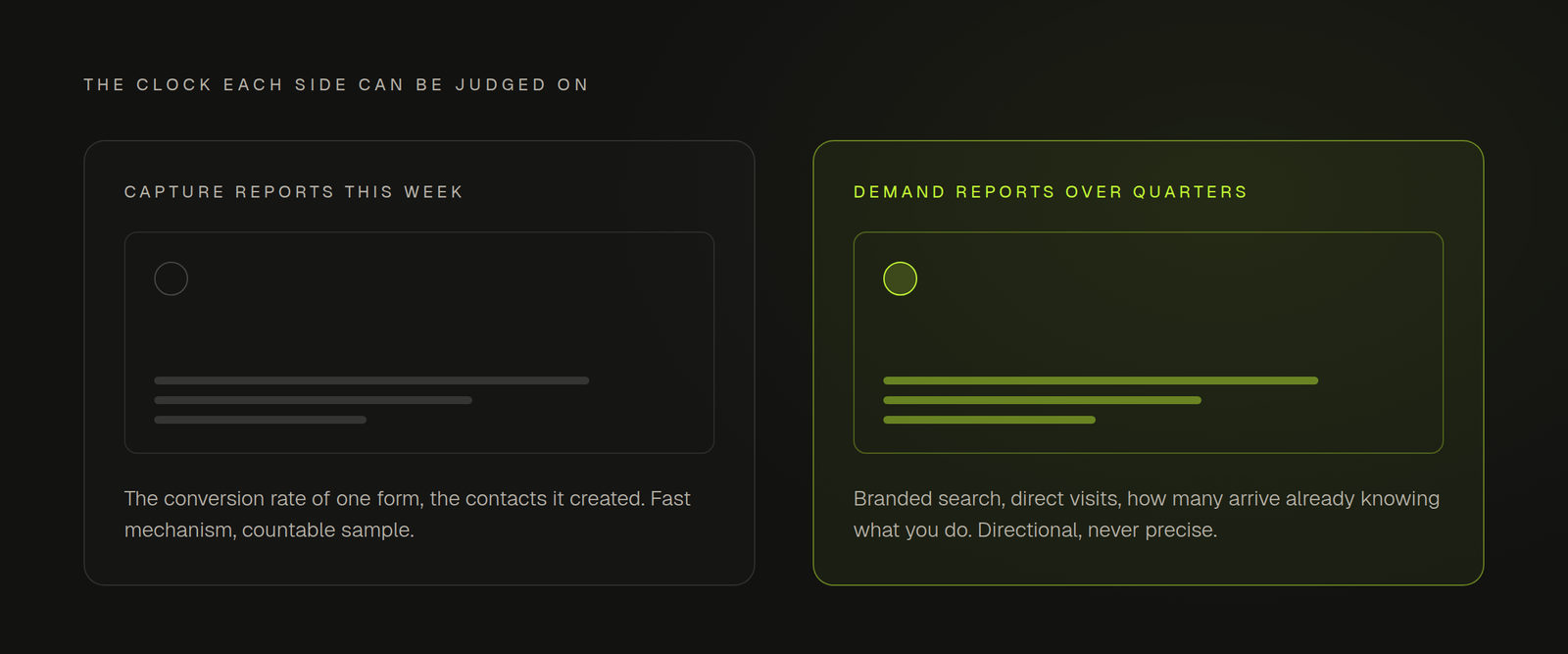
A metric belongs to the stage that can actually move it. Demand work answers to aggregate, directional numbers read over quarters: branded search, direct and returning visits, the share of enquiries that arrive already knowing what you do, and whether the pieces that start a path keep appearing in the paths that end well. None of those is precise, and precision is not what they are for. They tell you whether more of your market knows you exist, which is the only thing consistent distribution can fairly be held to.
Capture answers to per-event numbers read over weeks: the conversion rate of a given page or form, the stage progression of the contacts it creates, and what those contacts prove to be worth. Those are fair to judge quickly, because the mechanism is fast and the sample is countable.
No measurement setup will hand you a clean split of credit between the two. Attribution assigns a conversion to a touch; it cannot tell you whether that person would have converted without the other nine. Read the two sides next to each other instead and watch whether they move together, which is what a feedback loop is good for. Rising demand with flat capture points at the conversion step. Flat demand with rising capture is usually borrowed from the pool.
Frequently Asked Questions
What is demand and lead generation?
Demand generation is the work that creates awareness and preference in a market: content, distribution, search presence and reputation. Lead generation turns an interested person into an identified contact through a form, a gated asset or a booking page, then segments that contact so the follow-up fits. Demand generation vs lead generation is a division of labour inside one funnel, not a choice between two strategies.
What is a demand generation example?
A weekly article answering a question your buyers actually search for, published where they already read, with nothing gating it. A conference talk, a podcast appearance, or a comparison page that helps somebody decide against you all qualify. The common feature is that they shift interest without asking for anything back, and they work on people who will never identify themselves. Put a form in front of the same asset and it becomes capture, reaching fewer people.
What is the biggest mistake in lead generation?
Capturing contacts faster than you create the interest that fills the pool. A form converts some share of the people who reach it, so its output is capped by the demand upstream. Optimising the form while the upstream work is cut produces a rising conversion rate on a falling number, which reads as progress for about a quarter. The other common mistake is treating every captured contact as equally ready to buy.
Conclusion: Demand Generation vs Lead Generation Is a Sequencing Question
Demand has to exist before anything can capture it, so neither the order nor the reporting is a matter of taste. Give demand work a directional metric read over quarters, give capture a per-event metric read over weeks, and stop asking the first to justify itself in the currency of the second. Most of the waste in the demand generation vs lead generation argument starts as a measurement error and becomes a budget error, which is why naming the job of each piece matters more than the volume you publish.
Sempyo sits on the demand side of that line: finished, designed posts in your voice, published week after week, so the pool your forms draw on keeps growing instead of thinning. If that is the side of the equation your week keeps losing, it is worth a look.