A content calendar is the record of what your business decided to publish, for whom, and why. Dates are the easy part. The calendar earns its keep when every entry names an audience, an outcome, an owner and a signal before it gets a slot.
TL;DR: A calendar that holds only dates and topics schedules work without deciding anything, so it stops being useful the first busy week. Give every row four fields, audience, outcome, owner and signal, and the same document starts telling you what to drop as well as what to make.
A pattern we keep seeing: the calendar gets built properly, filled in carefully, then quietly abandoned once the first hard week arrives. The usual explanation is discipline, and we think that diagnosis is wrong. A document you stop opening is usually a document that was never answering a question you actually had.
Dates were never the hard part. Deciding what deserves a date is.
A Content Calendar Is a Decision Record
What is a content calendar? It is a single document that holds every planned piece of content together with the decisions behind it: who it is for, what it should change, who owns it, and how you will know whether it worked. A posting schedule is the output of those decisions, not a replacement for them.
Most templates get this backwards. They hand you columns for date, channel and topic, which are the three things you could reconstruct from your own feed afterwards. What they never ask is why this piece, for this person, this week.
The version worth building is closer to a decision log. Each row commits to something that can turn out to be wrong, and that is the point. A plan you cannot be wrong about is not a plan, it is a list.
None of this is a new idea, it is just rarely applied to the calendar itself. Nielsen Norman Group's overview of content strategy, drawing on Kristina Halvorson's 2009 definition, holds that a strategy ensures that every piece of content in the experience serves and sustains a legitimate purpose. The calendar is where that promise either gets kept or gets lost, because it is the only place where a vague intention has to become a row with a name on it.
The Difference Between a Schedule and a System
A schedule tells you what happens next. A system tells you what to do when the plan meets reality, which happens most weeks.
Put two versions of one row side by side and the gap stops being theoretical:
- As a schedule: Tuesday, LinkedIn, post about onboarding, draft due Friday. Every field is true, and none of it is a decision.
- As a decision: for founders who have just hired their first employee, to make the onboarding gap feel solvable rather than shameful, owned by one person, judged on replies from that audience rather than on reach.
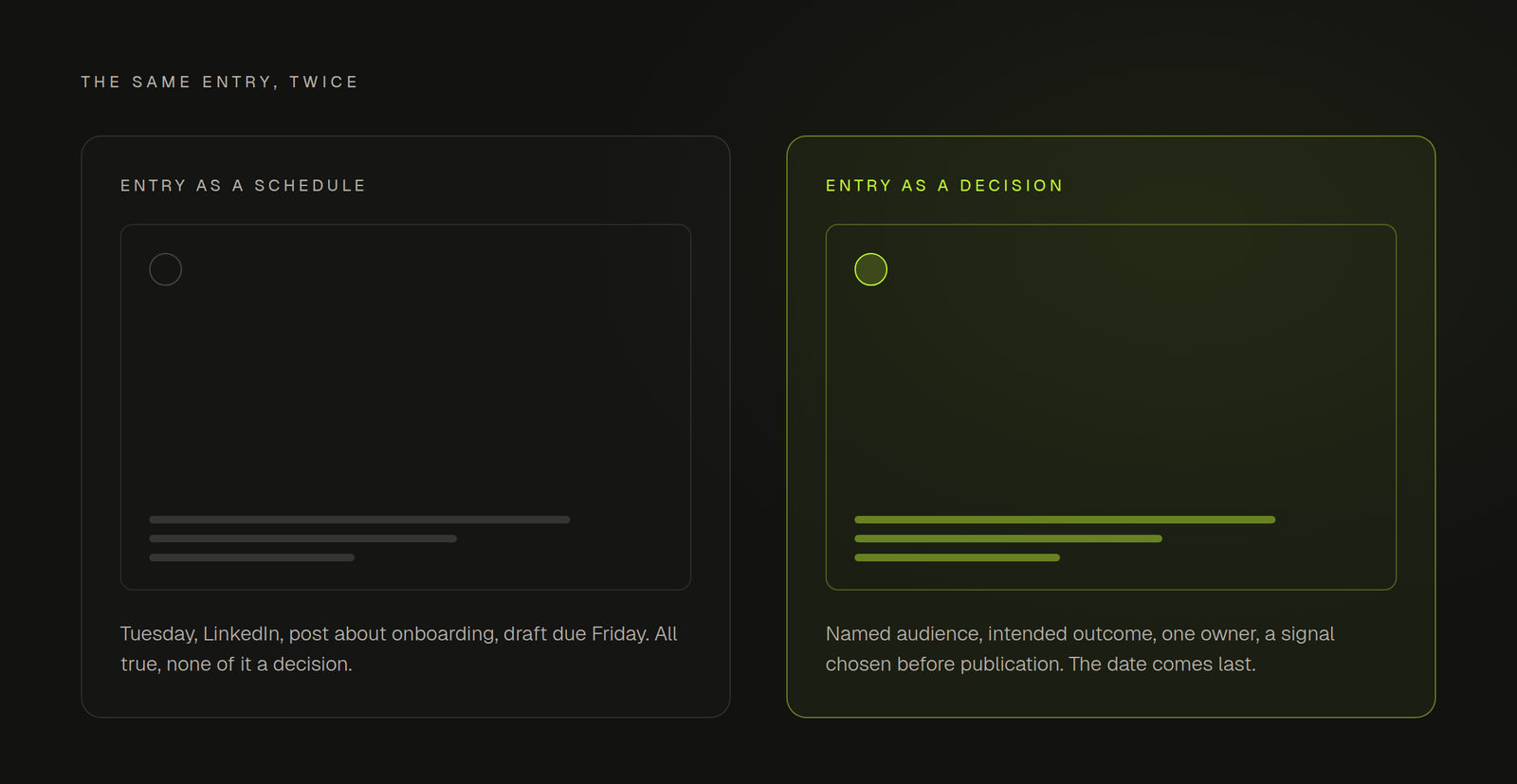
The second version can be argued with. Someone can say the audience is wrong, or that replies are the wrong signal, or that this piece should wait a month. That argument costs nothing in a planning document and a great deal after publication.
The date is the last decision an entry earns, not the first one it gets.
This is also what makes a content calendar survivable. When a week collapses, a schedule gives you no basis for choosing what to drop, so everything slips by the same amount and the most important piece slips with the rest. A system gives you a ranking, because some outcomes matter more this quarter than others and the rows say so.
There is a second-order benefit worth naming. A row that gets dropped with its decision intact returns to the backlog still carrying its audience and its intended outcome, so nobody has to re-argue it when a slot opens later. Calendars that hold only dates lose that reasoning the moment a row moves, which is why rescheduling so often turns into rewriting.
The Four Decisions Every Entry Has to Carry
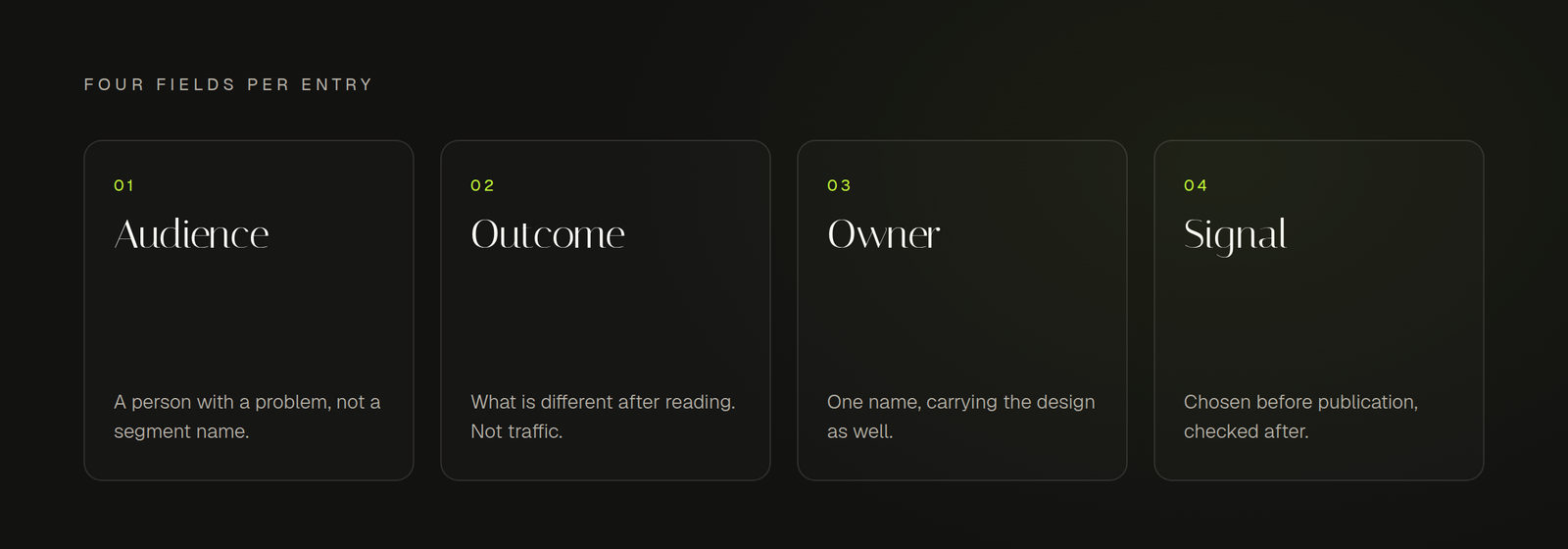
Four fields, one line each. If a row cannot fill them, it is not ready for a date.
- Audience. A person with a problem, not a segment name. "Consultants" is a category. "A consultant whose referrals have dried up" is an audience, and it changes the first sentence you write.
- Outcome. What is different after someone reads it. Traffic is not an outcome, it is a precondition for one. "Understands why their proposals stall" is an outcome.
- Owner. One name, carrying the design as well as the words. Shared ownership is the most reliable way to produce something that arrives late and looks off-brand.
- Signal. Chosen before publication, never after. Deciding what would have counted as working once the numbers are in front of you is not measurement, it is storytelling.
The signal field is the one most teams skip, and it is the one that makes the whole thing self-correcting. If you decide up front that a piece exists to earn qualified replies, then good reach with no replies is a clear result instead of an ambiguous one. You learn something either way, which is the loop that performance feedback is supposed to close.
Notice what the four fields do to the weekly conversation. The question stops being "what should we post on Tuesday", which has no correct answer, and becomes "which of these four rows deserves the slot", which does. The same four fields scale down to a single channel and up to a quarter, and the quarterly version is its own discipline: we cover it separately in a piece on turning marketing content planning into a system you can repeat.
Why Content Calendars Quietly Stop Working
Three failure modes, roughly in the order they show up.
The calendar becomes a quota. Once the goal is filling every slot, the questions stop being editorial and start being logistical. Google's guidance on helpful content asks publishers to check whether they are producing lots of content on many different topics in hopes that some of it might perform well in search results, which is a fair description of what a quota produces. The counter-test, from the people-first side of that same guidance, is simpler: is there an audience that would find this useful if they came to you directly? A quota cannot answer that question, because it was never asked.
The calendar outgrows its owner. Colour-coded tabs, dependencies between rows, a field for every eventuality. Elaborate calendars fail for the same reason elaborate expense systems do: the maintenance cost lands on one person who never agreed to carry it. The honest fix is subtraction, which is why we would argue for a simple editorial calendar that one person can actually keep over anything that needs a maintainer.
The calendar plans pieces instead of arguments. A row that says "blog post about pricing" treats the artefact as the unit. But the same argument has to arrive in several places before it lands, so the unit is the argument and the channels are its forms. Planning the piece and planning where it lands in one document is what stops distribution becoming the thing you think about after the writing is done. The social version of that problem is specific enough to deserve its own treatment, which is an editorial calendar built around a real social media workflow.
Maintenance Belongs in the Calendar
Most content calendars only look forward. That is half a system, because everything you have already published keeps making promises on your behalf, and some of those promises went stale months ago.
Nielsen Norman Group treats this as governance: the part of content strategy that determines when and how content is maintained, updated, and removed. Their overview of content strategy puts a floor under the cadence too, recommending that you start with at least a 3-month interval for reviewing content and supporting collateral, and it suggests forming a content-governance council to decide what happens to work that is outdated or underperforming. In a small business that council is one person and a recurring hour, which is enough.
The mechanism matters more than the interval. A review only works if it ends in a decision, so give every existing piece exactly one of three outcomes:
- Keep. Still true, still findable, still pointed at someone. Leave it alone.
- Update. The argument holds but the specifics have aged. Give it an owner and a date, in the same calendar as new work.
- Remove. It no longer reflects what you believe or what you sell. Taking it down is a legitimate outcome, not an admission.
Anything that leaves a review as "we should probably look at that" will be there next quarter, unchanged, quietly contradicting a newer page.
Where Scheduling Tools Actually Help
None of this is an argument against scheduling. Publishing on time, without somebody sitting at a keyboard on a Tuesday morning, is a real gain, and the platforms hand it to you at no cost. LinkedIn lets a Page admin schedule a post anywhere between an hour from the current time to three months in advance, natively, with no third party involved.
Which is rather the point. If scheduling is free and built in, a tool's value cannot be the scheduling. Its value is whatever helps you decide, and most of the deciding still happens in the document rather than in the queue.
So the practical division of labour looks like this:
- The calendar holds the decisions and the reasons behind them.
- The scheduler holds the timing and the delivery.
- The review moves finished work between keep, update and remove.
Two of those three are mechanical. The third is judgment, and it does not get easier with a better template.
If you want the strategy layer settled before the rows get filled, that is the job an AI content strategy should be doing, and it is the first thing our Blueprint captures: voice, positioning and audience, written down before anyone argues about a Tuesday.
Key Takeaways
- A schedule records dates. A content calendar records decisions.
- Every entry needs an audience, an outcome, an owner and a signal.
- Choose the success signal before publishing, never afterwards.
- Filling slots is a quota, and quotas produce content nobody asked for.
- Review published work on a standing interval, ending in keep, update or remove.
- Scheduling is a commodity. The decision behind the row is not.
Frequently Asked Questions About Content Calendars
What does a content calendar do?
A content calendar records what you plan to publish and the reasoning behind each entry: the audience, the intended outcome, the owner, and the signal you will judge it by. Done properly it also tells you what to cut when a week goes wrong, which a plain posting schedule can never do for you.
What is the best way to make a content calendar?
Start with the decisions rather than the grid. Write the audience, outcome, owner and signal for the next four entries, then give those entries dates. A short plan you can defend beats a quarter of colour-coded rows nobody revisits. Add structure later, only when a real problem asks for it.
How to structure a content calendar?
Use the four decision fields per row, plus the practical ones you genuinely need: channel, date and status. Keep published work in the same document with a review date, so maintenance sits beside planning instead of in a forgotten tab. If a field never comes up in a weekly conversation, delete it.
Conclusion: The Date Comes Last
A content calendar is worth the effort when it changes what you make, not merely when you make it. In practice that means fewer rows, each carrying a decision somebody could disagree with, and a standing review that lets older work earn its place again or lose it.
That is also the part nobody wants to run every week, which is the honest reason most calendars go quiet. If you would rather the deciding, designing and publishing simply happened, in your voice, week after week, our pricing page is the short version. Good businesses should not go quiet because the calendar got heavy.