Most brand voice guide examples circulating online are adjective lists: this brand is confident, that one is playful. They describe a voice without letting anyone reproduce it. The examples worth copying are the style guides organisations publish for their own writers, because those are written as rules rather than impressions.
TL;DR: The useful examples are not listicles about famous brands. They are the working style guides those organisations publish, and two of the best known are open to read right now. One gives per-word rulings. The other separates voice from tone and says when each shifts. Judge any example by whether a writer, or a model, could follow it without guessing what you meant.
Why Most Brand Voice Guide Examples Are Not Examples at All
A search for the term returns roundups of well-known brands with three adjectives attached to each. That is a description of an outcome. It tells you what a voice sounds like once it has been executed well, and nothing about the decisions that got it there.
What is a brand voice guide example? It is a published document showing how a specific organisation writes: its voice attributes, the rule that carries each attribute, the words it prefers and refuses, and sample sentences in both the right and the wrong register. A list of adjectives about a famous brand is a description of a voice, not an example of a guide.
The distinction matters more now than it used to. When only people wrote the copy, an adjective was a usable shorthand, because a writer fills the gaps with judgment. Hand the same adjective to a model and it fills the gaps with the average of everything it has read. Our own guidance on building a brand voice guide that survives automation covers why that averaging happens and what structure prevents it.
Two Public Brand Voice Guide Examples Worth Reading
Both are free, both were written for internal use rather than as marketing, and both have been maintained for years. That last part is the tell. A guide nobody maintains is a guide nobody uses.
The first is the UK government's style guide, arranged alphabetically so that individual words get individual rulings. It tells writers to use "use" instead of "utilise", to write "cannot" rather than "can't", and to prefer "select" over "click" because not all users click. There is nothing to interpret. Each entry names the case and settles it.
The second is Mailchimp's content style guide, which separates the two things most guides run together. It states that "You have the same voice all the time, but your tone changes", then tells writers to consider the reader's state of mind before choosing a tone: relieved, confused, or asking for help in public. Voice is fixed. Tone is a variable with named inputs.
An adjective describes the result. A rule produces it.
The Four Parts a Usable Example Contains
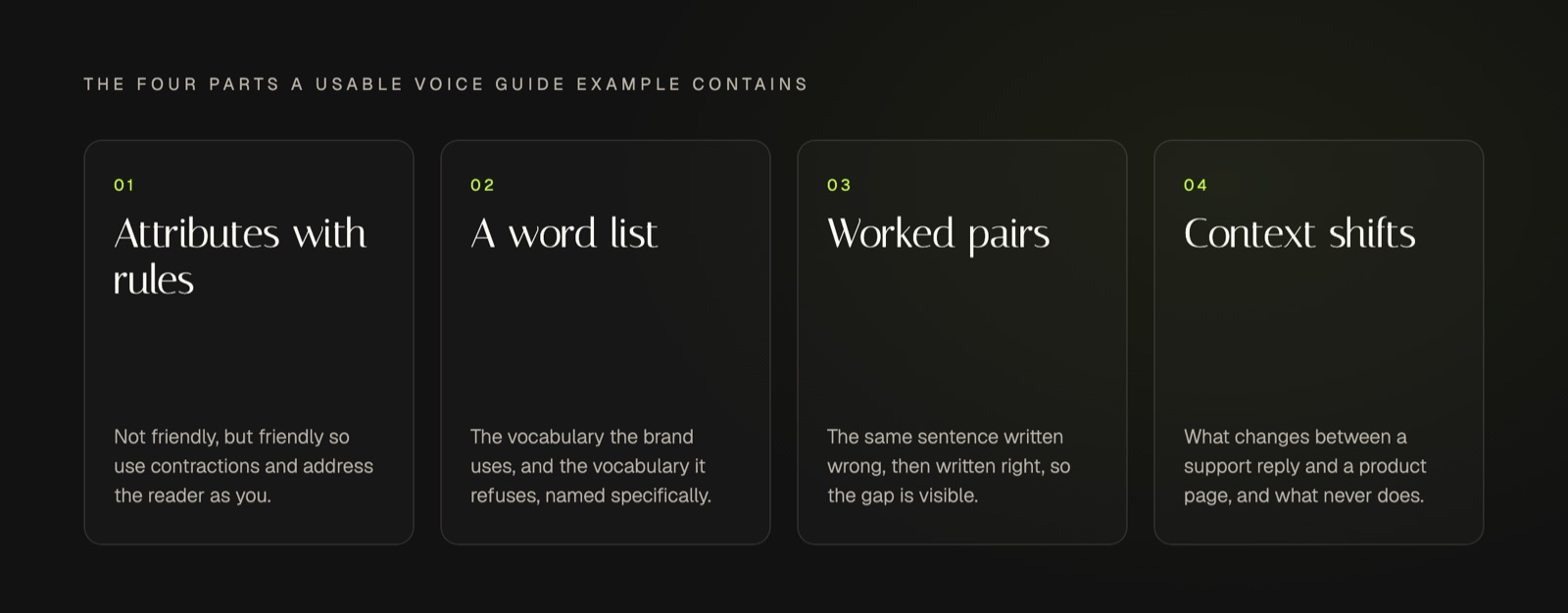
Read enough published guides and the same four parts appear, in different proportions but rarely absent. The strongest brand voice guide examples carry all four; the weak ones stop after the first.
- Attributes with rules attached. Not "friendly", but "friendly, so use contractions and address the reader as you".
- A word list. The vocabulary the brand uses, and the vocabulary it refuses, named specifically enough to check against a draft.
- Worked pairs. The same sentence written wrong and then written right, so the difference is visible rather than described.
- Context shifts. What changes between a support reply, a product page and an apology, and what never changes.
The fourth part is the one most often missing, and its absence shows up fast in practice. Without it, every piece of writing gets the same register, which reads as tone-deaf the moment something goes wrong and the copy stays chirpy.
How to Test an Example Before You Copy It
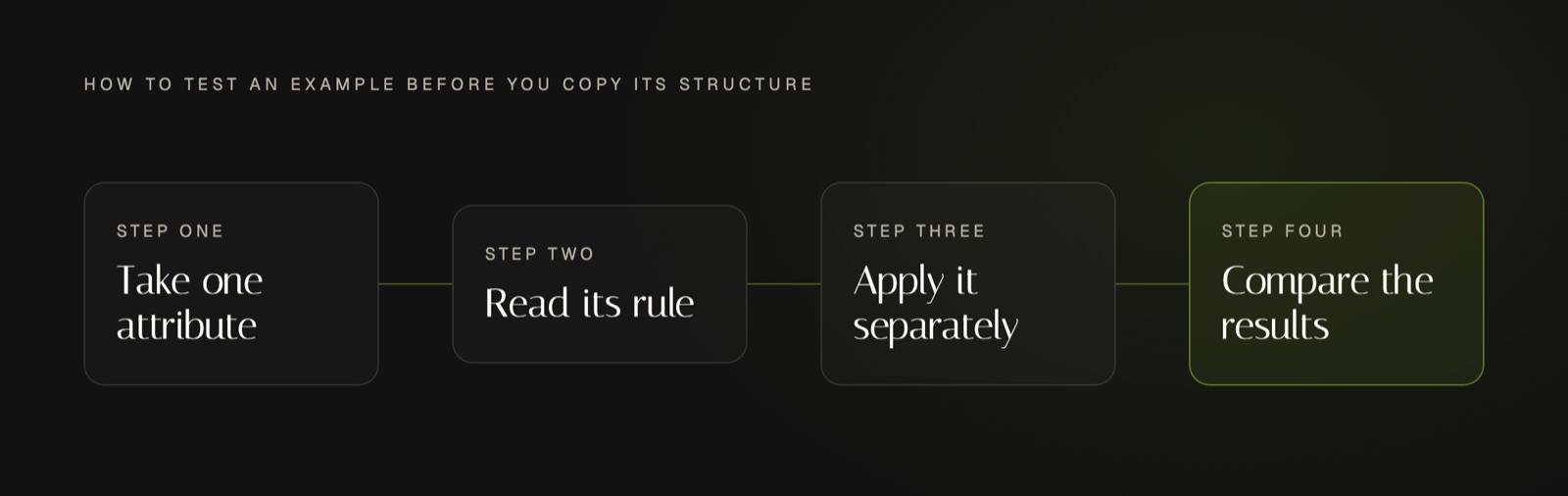
You do not need to read a guide end to end to know whether it is worth borrowing from. Take one attribute out of it, follow the rule that sits underneath, and see whether two people writing separately land in the same place.
If they do, the rule is doing the work. If they diverge, the guide is still describing rather than instructing, and copying its structure will reproduce the same gap in yours. The same test works with a model, which is a faster and less forgiving version of the same check, since a model will not quietly fill in what you left out. Our walkthrough on turning an existing prose guide into rules a model can follow sets out the four passes that close those gaps.
Borrow structure, never sentences. A voice that reads as someone else's is worse than no voice at all, and what is worth taking from brand voice guide examples is the scaffolding: how they order attributes, how they phrase a rule, how they pair a bad example with a good one.
Frequently Asked Questions
What are examples of brand voice?
Brand voice is usually named as a small set of attributes, three to six, each carrying a rule. Plain, direct and warm is one such set. On its own the list is not usable, so the working examples are documents that state what each attribute permits and forbids in a sentence.
What is a brand voice guide?
It is the document that fixes how an organisation writes across every channel: voice attributes, the rules underneath them, preferred and banned vocabulary, sample sentences, and how tone shifts by context. Its job is to make consistency reproducible by someone who was not in the room when the brand was defined.
How do you write a brand voice guide?
Start from writing you already have rather than from adjectives. Pick pieces that sound right, name what they have in common, then turn each observation into a rule with the reason attached. Add the vocabulary lists, then a worked pair per attribute. Publish it where writers actually work.
Conclusion
The gap between the brand voice guide examples people share and the ones people use is the gap between describing a voice and specifying it. Public style guides are worth reading precisely because they were built to be followed under time pressure, by writers who did not define the brand and will not ask.
Sempyo starts from the same principle, capturing voice, positioning and visual identity as a Blueprint before anything is written or designed, so that what goes out sounds like you week after week. Worth a look if your guide currently lives in a slide deck nobody opens.