The brand archetypes wheel is a circular diagram that arranges twelve character types, from the Innocent to the Ruler, around a single ring so you can see how they relate. It is a visual aid for choosing one consistent personality for your brand, not a scientific instrument.
TL;DR: The wheel organises twelve archetypes into a circle, usually split into four groups. The twelve come from Mark and Pearson's branding work, built on Jung's older idea of archetypes. The wheel is useful for picking one clear identity, as long as you treat the neat quadrant labels as a convention rather than a law.
The Real Origin of the Brand Archetypes Wheel
Most guides credit the wheel to Carl Jung. That is only half right, and the half that is wrong matters. Jung gave us the concept of archetypes and the collective unconscious, the shared symbolic patterns he wrote about across his essays on archetypes and the collective unconscious. He never published a list of twelve, and he never drew a wheel.
The twelve you see today were assembled for marketing by Margaret Mark and Carol S. Pearson in their 2001 book on brand archetypes. So the diagram sits on a real psychological foundation, but the specific set of twelve and the circle that holds them are a branding construction laid on top. Knowing that keeps you honest about how much certainty the picture actually carries.
What Are the 12 Brand Archetypes on the Wheel?
The twelve are the Innocent, the Explorer, the Sage, the Hero, the Outlaw, the Magician, the Regular Guy or Gal, the Lover, the Jester, the Caregiver, the Creator, and the Ruler. Each names a recognisable way of being in the world, and each carries its own tone, values, and typical language.
What is the brand archetypes wheel? It is a reference chart that places all twelve of these characters in one ring, grouped by what drives them, so a brand can locate the single identity that fits it best and see which neighbours it is close to. The wheel is the map; the archetype you land on is the destination.
The Four Groups That Give the Wheel Its Meaning
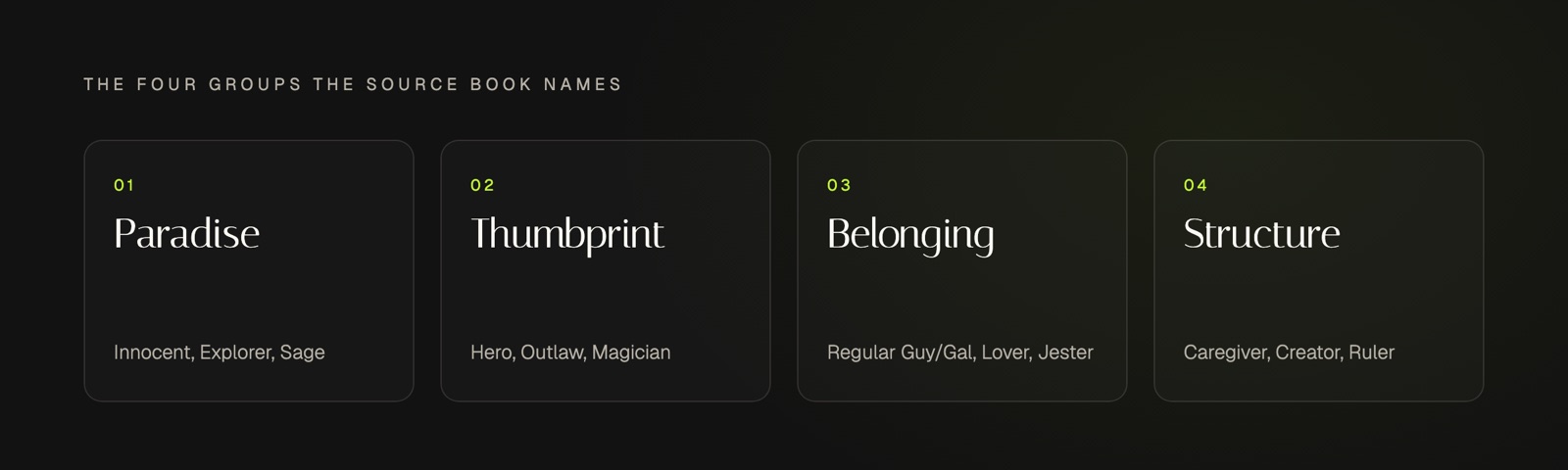
The circle is not random. In the source book the twelve are sorted into four named groups, each answering a different human need. This is the part worth internalising, because the grouping, not the pretty ring, is where the real logic lives.
- The Yearning for Paradise: Innocent, Explorer, Sage. Driven by the search for a better inner state, whether safety, freedom, or understanding.
- Leaving a Thumbprint on the World: Hero, Outlaw, Magician. Driven to change what is around them.
- No Man or Woman Is an Island: Regular Guy or Gal, Lover, Jester. Driven by connection and belonging.
- Providing Structure to the World: Caregiver, Creator, Ruler. Driven to build order and lasting things.
The four names above are taken directly from the publisher's own listing of the book's contents. Archetypes that share a group share a motive, which is why a brand can often shift one step sideways without losing itself, but rarely jump across the wheel and stay believable.
A caution worth stating plainly: many versions of the wheel add two axes and four motivation quadrants with tidy labels like freedom and order. Those labels vary from chart to chart and are a later convention, not part of the original framework. Treat them as a helpful sketch, not gospel.
How Do You Find Your Place on the Brand Archetypes Wheel?
Start from motive, not aesthetics. Ask what your brand is fundamentally for: comfort, mastery, rebellion, belonging, or order. That answer points you at one of the four groups before you ever compare individual characters. Only then narrow to a single archetype inside it.
Pick one primary archetype and, at most, one supporting influence. Brands lose the plot when they claim four at once, because the whole value of the brand archetypes wheel is the discipline of choosing. If you want the strategic reasoning behind that discipline, our guide on how to use brand archetypes for clearer marketing decisions covers how a single identity should shape real choices, from copy to colour.
The test of a good choice is whether it changes what you make. If naming your archetype does not alter a headline, a layout, or a photograph, you have chosen a label, not an identity.
Frequently Asked Questions
What Are the 12 Original Archetypes?
In branding, the twelve are the Innocent, Explorer, Sage, Hero, Outlaw, Magician, Regular Guy or Gal, Lover, Jester, Caregiver, Creator, and Ruler. This particular set was defined by Mark and Pearson for marketing in 2001. Jung's own writing describes archetypes as a concept but never fixes them at twelve.
Is the Brand Archetypes Wheel Based on Jung?
It is built on Jung's idea that humans share deep symbolic patterns, so the foundation is genuinely his. The wheel itself, and the exact list of twelve marketing characters arranged on it, came later from Mark and Pearson. Calling the brand archetypes wheel purely Jungian overstates what he actually wrote.
What Are the 12 Types of Archetypes?
They are the same twelve characters, sorted into four motivational groups: the yearning for paradise, leaving a thumbprint on the world, connection and belonging, and providing structure. Each group holds three archetypes that share a driving need, which is what gives the circle its underlying order.
The Bottom Line
The brand archetypes wheel earns its place when you use it to commit to one identity and then act on it, week after week, across everything you publish. It stops being useful the moment it becomes a personality quiz you admire and forget. The point was never the diagram; it was consistency in your own voice.
That consistency is exactly what a system is built to hold. Sempyo captures your positioning and voice as a Blueprint and turns it into finished, on-brand posts, so the archetype you choose actually shows up in what goes out. Worth a look if holding one identity across every channel is the part that keeps slipping.
Key Takeaways
- The wheel arranges twelve archetypes in a circle grouped by shared motivation.
- Jung gave the concept of archetypes; the twelve marketing types came from Mark and Pearson in 2001.
- The four named groups, not the quadrant labels, carry the real logic.
- Choose one primary archetype, plus at most one supporting influence.
- A real choice changes your copy, layout, and imagery, not just a label.