To find your brand identity, a brand archetypes quiz is the fastest first step: a few honest questions that sort you toward one of twelve recognizable personality patterns. You can take a short one right here as you read, then use the rest of this guide to turn that one-word result into an identity you can actually use.
The six questions below place you in one of the four archetype families in about two minutes. That is the easy part. Knowing you scored as the Sage is easy; turning that word into a voice, a look, and a week of posts is where the real decisions live, which is what everything after the quiz is for.
TL;DR: A brand archetypes quiz is a fast diagnostic that names your dominant personality pattern from a set of twelve. Treat the result as a hypothesis to test against your actual audience and content, not a verdict. The value is in what you do after the score, not the score itself.
What a Brand Archetypes Quiz Actually Measures
Most quizzes work by mapping your answers onto the twelve archetypes that Margaret Mark and Carol S. Pearson organized for branding into four groups, from the Innocent and the Sage to the Outlaw and the Ruler. A brand archetypes quiz asks about your motivation, your tone, and the feeling you want customers to leave with, then weights those answers toward the pattern you lean on most.
What is a brand archetype? A brand archetype is a universal character pattern, such as the Sage, the Hero, or the Outlaw, that gives a brand one consistent motivation and voice. It is shorthand for how your brand behaves, so every post, tagline, and design choice can trace back to a single coherent personality rather than a committee of moods.
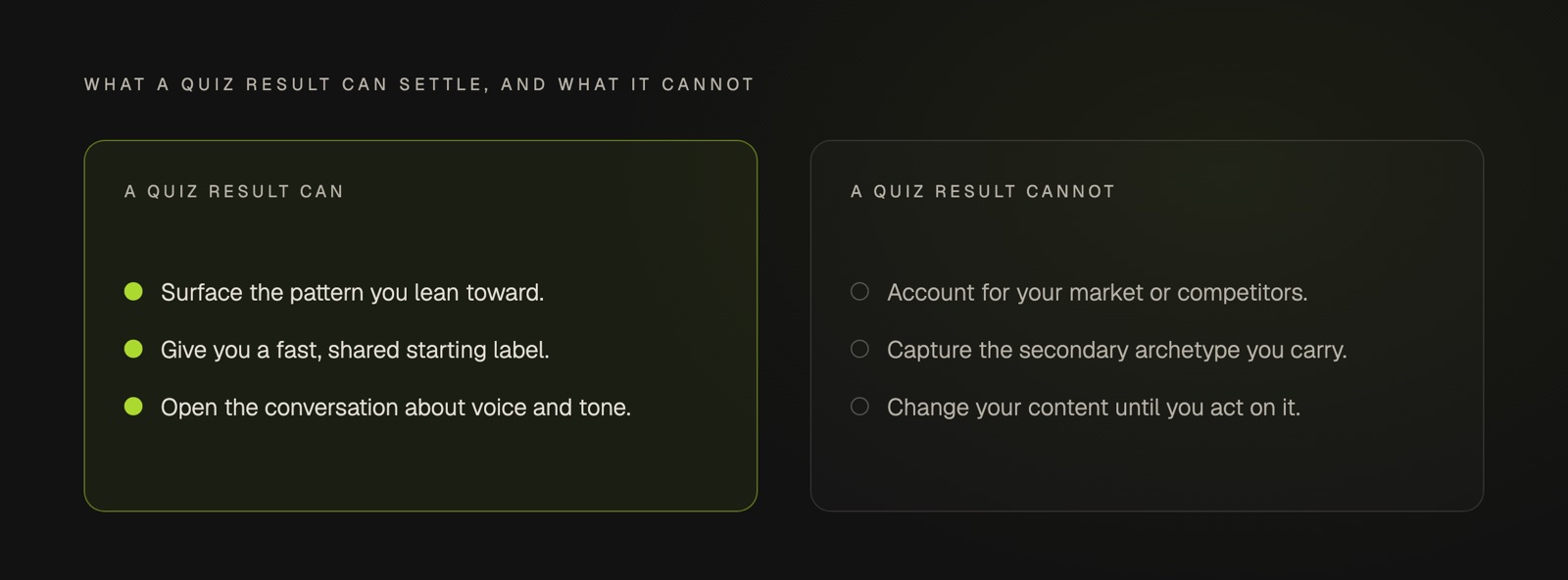
What the quiz measures well is your instinct. What it cannot measure is your market. Two founders can answer identically and still need different brands, because one sells to cautious buyers who want reassurance and the other to restless ones who want a challenge. The score reflects you; it says nothing about the people you are trying to reach.
The Brand Archetypes Quiz: Take It as You Read
Answer these six questions with your gut, note the letter each time, and tally them at the end. It places you in one of the four archetype families, which is the fastest honest read a short quiz can give.
1. What does your brand most want to give people?
- A. Truth, clarity, and a little optimism.
- B. The push to challenge something and change it.
- C. Warmth, belonging, and a good time.
- D. Order, safety, and something built to last.
2. How should customers feel after reading you?
- A. Reassured that you are honest.
- B. Fired up to act.
- C. Like they belong with you.
- D. In safe, capable hands.
3. Which compliment would make you proudest?
- A. You always tell it straight.
- B. You do things nobody else dares to.
- C. You feel like one of us.
- D. You are the one we can rely on.
4. What is your instinct when the market moves against you?
- A. Step back and find the true answer.
- B. Break the rule and lead.
- C. Bring people together around it.
- D. Set the standard and hold it.
5. Which single word is closest to your brand?
- A. Wise.
- B. Bold.
- C. Genuine.
- D. Trusted.
6. Which reputation would you least want?
- A. Naive or vague.
- B. Reckless.
- C. Needy.
- D. Rigid.
Now tally your letters. Whichever you chose most points to your family:
- Mostly A, the truth-seekers: Innocent, Explorer, or Sage.
- Mostly B, the mark-makers: Hero, Outlaw, or Magician.
- Mostly C, the connectors: Regular Guy or Gal, Lover, or Jester.
- Mostly D, the builders: Caregiver, Creator, or Ruler.
A tie is normal and useful, because most brands run one dominant family with a second shading it. Take the family you scored highest, pick the one of its three that sounds most like how you actually talk to customers, and read on to turn that into real decisions.
How Do You Find Your Brand Archetype?
You find your archetype by looking at evidence, not just intuition. Read back your last twenty posts, your homepage, and the way you talk to a good customer, then ask which pattern keeps showing up. A quiz is a fast first pass at that question, but a careful read of what you already publish is usually more honest than a set of hypothetical answers.
The stronger method is to run the quiz result against reality. If it says Creator, check whether your content actually prizes craft and originality or whether that is who you wish you were. Our guide to using brand archetypes to make clear marketing decisions walks through turning a label into concrete choices about voice, imagery, and message.
An archetype is a filter for decisions, not a badge for your website. If it never changes what you publish, you have a personality test, not a brand.
Can a Free Brand Archetypes Quiz Define Your Brand?
No. A free brand archetypes quiz can start the conversation, but it cannot define your brand on its own. Free quizzes use short question sets and generic scoring, so they tend to surface the obvious answer and miss the blend most brands actually live in. They are a useful mirror, not a strategy.
The reason is structural. A ten-question quiz has to round you to a single winner, yet real brands usually run a dominant archetype with a secondary one shading it, which is why understanding how the archetypes sit next to and against each other on the wheel matters more than the headline result. A quiz gives you the loudest note. Your brand is the chord.
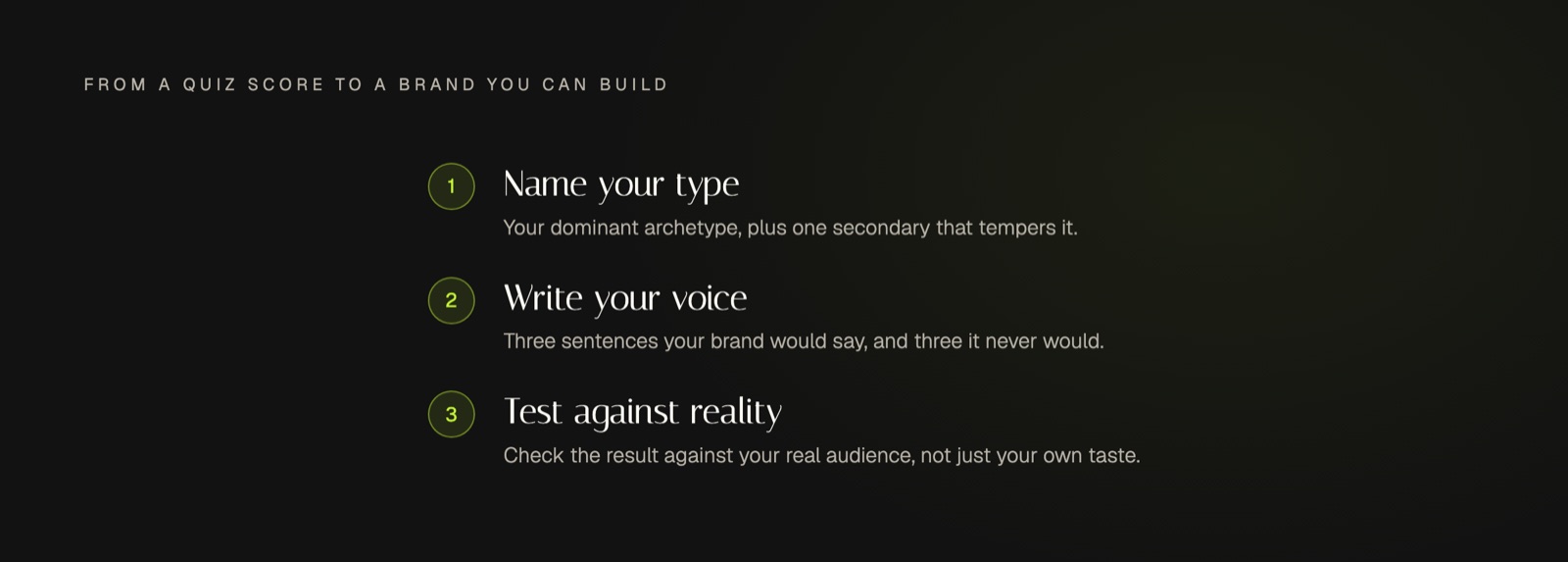
To move from a quiz score to something you can build on, do three things:
- Name your dominant archetype and one secondary that tempers it.
- Write three sentences your brand would say and three it never would.
- Check the result against your real audience, not just your own taste.
From Quiz Result to Real Brand Decisions
The gap most brands fall into is the one right after the result. You get a name, you feel understood, and then nothing about your actual content changes. The result only earns its keep when it starts settling arguments: which headline, which photo, which of two captions sounds like you and which sounds like everyone else.
That is the difference between a label and a system. A single archetype held consistently across a Tuesday post, a Thursday email, and a Sunday story compounds into recognition. This is where a Blueprint does the work a quiz cannot: Sempyo's Blueprint captures your voice, positioning, and visual identity once, then holds every finished, designed post to that standard week after week. The quiz names the note; the Blueprint keeps you in tune. For a fuller tour of the framework behind the score, see the twelve brand archetypes and what each one stands for.
Brand Archetypes Quiz FAQ
What are the 12 brand archetypes?
The twelve are the Innocent, Explorer, Sage, Hero, Outlaw, Magician, Regular Guy or Gal, Lover, Jester, Caregiver, Creator, and Ruler. Popularized for branding by Mark and Pearson, they group into four broad motivations: seeking paradise, leaving a mark, connecting with others, and providing structure.
What archetype is Coca-Cola?
Coca-Cola is most often placed as the Innocent, an archetype built on optimism, simplicity, and nostalgia. Its long-running visual signatures and feel-good messaging lean on that pattern, which is a clear example of how a single archetype, held for decades, becomes instantly recognizable without a word of explanation.
Are brand archetypes quiz results accurate?
They are directionally accurate, not definitive. A quiz reliably surfaces the pattern you lean toward, which is genuinely useful. It cannot account for your market, your competitors, or the secondary archetype most brands carry, so treat the result as a strong hypothesis to confirm against your real content and audience.
The Bottom Line on Finding Your Identity
A quiz is a good door and a poor room. It gets you to a name quickly, and a name is worth having, but the brands that feel like themselves are the ones that turn that name into a standard and then meet it every single week. Sempyo exists so good businesses never go quiet, which starts with knowing exactly who you sound like and then showing up as that, consistently, in your own voice. Take the quiz, keep the result, and spend your real effort on what comes after it.