The list of 12 brand archetypes did not come from Carl Jung. It came from Carol S. Pearson, who published a set of twelve in 1991, and it reached branding a decade later through the book she wrote with Margaret Mark. Nearly every guide on the subject credits Jung for the list, and the mistake is not a footnote. It changes how much weight the framework can carry.
TL;DR: The 12 brand archetypes come from Carol S. Pearson rather than from Carl Jung. Jung described archetypes as inherited patterns; Pearson put a number on them in 1991, and the 2001 branding book carried them into marketing. The publisher's own contents page groups the twelve under four named parts, which is a safer map than the quadrant diagrams that circulate online. Choose the one your brand can hold in public, week after week.
The 12 Brand Archetypes Are Pearson's, Not Jung's
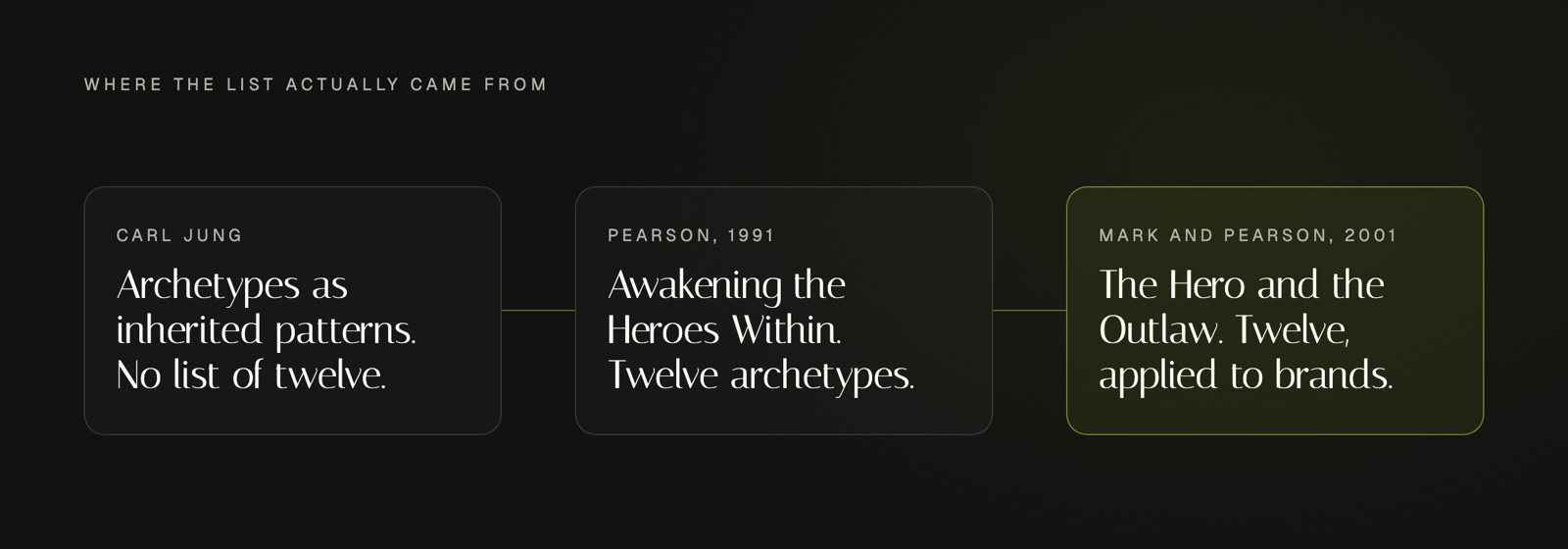
Jung's contribution is real but narrower than the internet suggests. His volume Archetypes and the Collective Unconscious, published as Part 1 of Volume 9 of the Collected Works, argues that certain figures and patterns recur across cultures because they are inherited rather than learned. It contains no numbered list, and no authoritative source attributes one to him.
The number twelve belongs to Pearson. Her 1991 book Awakening the Heroes Within carries the subtitle "Twelve Archetypes to Help Us Find Ourselves and Transform Our World", a decade before anyone applied the idea to brands. That application arrived in 2001 with The Hero and the Outlaw, written with Margaret Mark, and the publisher's own contents listing gives each of the twelve a chapter. Treat that 2001 set as the branding list. Do not assume Pearson's 1991 twelve match it name for name.
What are the 12 brand archetypes? They are twelve character patterns, each given a chapter in Mark and Pearson's 2001 book, that a brand can adopt as a consistent personality: Innocent, Explorer, Sage, Hero, Outlaw, Magician, the Regular Guy or Gal, Lover, Jester, Caregiver, Creator and Ruler.
Getting the attribution right is not pedantry. Jung's archetypes are a claim about the human psyche. Pearson's twelve are a working taxonomy, built first for personal development and then for positioning. Citing Jung for the list borrows scientific authority the list never had, which is how a useful tool ends up oversold.
The Four Groups the Publisher Actually Names
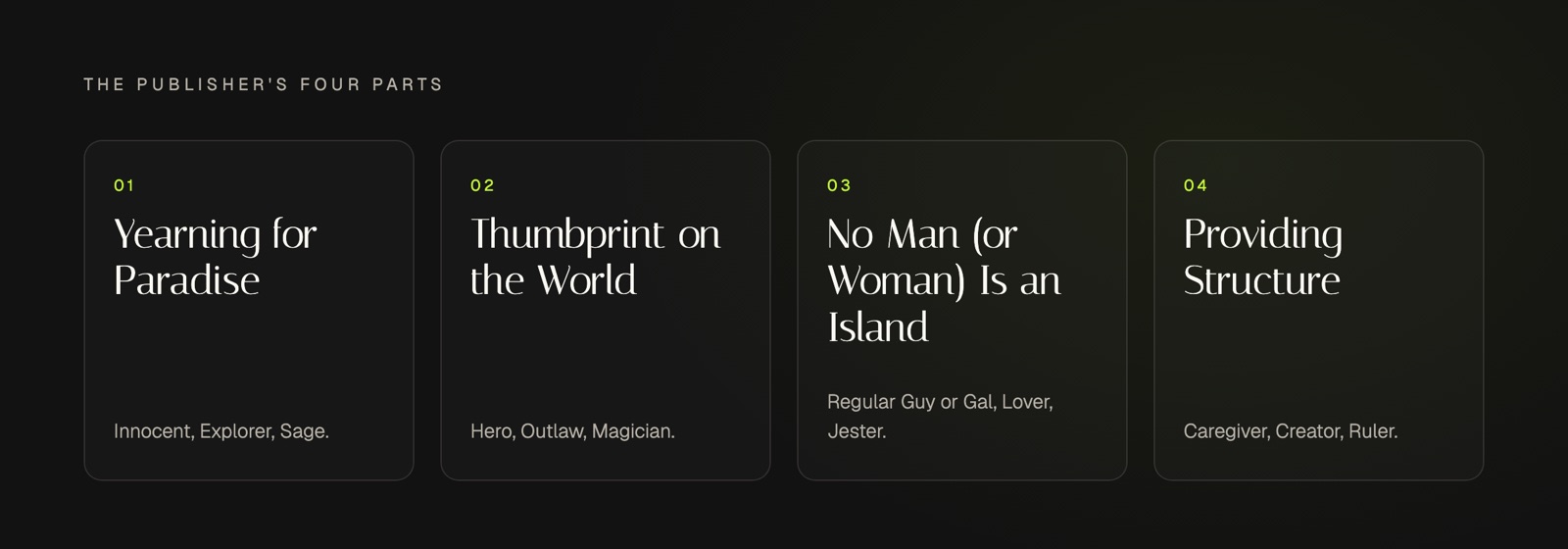
The book's own structure sorts the twelve under four headings, and those groupings tell you more about a candidate archetype than any personality quiz.
- The Yearning for Paradise: Innocent, Explorer, Sage. Identities built on clarity, discovery and understanding.
- Leaving a Thumbprint on the World: Hero, Outlaw, Magician. Identities built on effort, defiance and transformation.
- No Man (or Woman) Is an Island: the Regular Guy or Gal, Lover, Jester. Identities built on belonging, intimacy and delight.
- Providing Structure to the World: Caregiver, Creator, Ruler. Identities built on protection, craft and order.
The four part titles are the publisher's. The one-line readings after them are ours, offered as a way in rather than as doctrine.
You will also see the twelve arranged on a wheel, or plotted against two axes of motivation. Those diagrams are repeated everywhere, but we could not trace them to the book's own structure, so we would not rest a positioning decision on one. The four named parts above are what the publisher actually lists.
How to Choose Among the 12 Brand Archetypes
Most selection advice asks which archetype fits your values. That question is too easy to answer flatteringly. A better test is which one you can still sound like on a slow Thursday, in a caption, in a sales email, and in a piece of design nobody had time to art-direct. An archetype that cannot survive those conditions is a mood board, not a position.
Two constraints narrow the field quickly. The first is the category you sell in. A Jester works in snacks and struggles in tax advice, not because the pattern is weak but because the audience arrives in a different mood. The second is what you can actually produce. Creator and Magician both promise visible craft, and a brand that promises craft while publishing default templates contradicts itself in public.
Choosing is the easy half. Applying the choice consistently is where the work sits, and the guide to using brand archetypes as a filter for marketing decisions covers that side in full.
The part most guides skip is design. An archetype shows in typography, colour, crop and spacing well before anyone reads a word. A Ruler brand set in a loose handwritten face reads as a mismatch on sight. Capturing that visual half alongside the voice is the point of a Blueprint, and it explains why an archetype written only into a copy document tends to fade within a quarter.
One honest limit. An archetype does not create demand. It makes a brand recognisable and it makes decisions faster, which is worth a great deal across a year of output, and is still not a growth strategy on its own.
Frequently Asked Questions
What are the 12 archetypes?
Innocent, Explorer, Sage, Hero, Outlaw, Magician, the Regular Guy or Gal, Lover, Jester, Caregiver, Creator and Ruler, as set out in The Hero and the Outlaw. The publisher's contents page sorts them into four parts of three. Some guides substitute "Everyman" for the Regular Guy or Gal, but the book's own listing uses the longer name.
What brand archetype is Gucci?
Gucci has never published one, so any answer you find is somebody's reading of its output rather than a stated position. The same is true of almost every famous example used in these articles. Read them as illustrations of a pattern, and be wary of copying a brand whose archetype you inferred from the outside.
What are the 12 archetypes of design?
There is no separate design set. The phrase usually means the same twelve applied to visual identity rather than to copy: which typefaces, colours, image treatments and layouts a Sage or an Outlaw would plausibly use. That translation matters, because a brand whose words and visuals point at different archetypes reads as inconsistent even when nobody can say why.
Final Thoughts on Getting the List Right
The 12 brand archetypes are a good framework with a misattributed origin. Pearson named the twelve, the 2001 book carried them into branding, and Jung supplied the underlying idea rather than the list. Knowing which part came from where tells you how much the framework can carry: enough to keep a year of output coherent, not enough to settle a strategy on its own. If the archetype is clear and the output still looks like four different companies, the choice was never the problem. Nothing is holding it in place, week after week.