AI graphic design uses generative models to produce layouts, images and type treatments from a written instruction. It is fast, and the output is often good-looking. What it does not do on its own is stay recognisably yours from one post to the next, because nothing in the process remembers your brand.
AI graphic design has solved the blank page. Producing a competent layout now takes seconds, and the quality floor across the available tools is high enough that the old complaint about ugly output no longer holds. The problem has moved rather than disappeared: work that looks fine on its own still fails as a set, because nothing holds it to one visual standard. The useful question is no longer whether AI can design, but what you measure its output against.
What AI Graphic Design Actually Does Well
Start with the honest part. The generation problem is largely solved. Ask for a quote card, a product announcement, a two-column layout with a headline and a supporting image, and you will get something usable in seconds. The composition will be balanced. The type will sit on a sensible grid. Five years ago that output would have taken a designer an hour.
AI graphic design is the use of generative models to produce visual assets from written instructions, covering layout, imagery, colour and type. It spans full-generation tools that build a whole composition from a prompt, and assistive features that handle a single step, such as separating a subject from its background or refitting a frame to another aspect ratio.
The assistive half is where the gains are least disputed. Removing a background, extending an image to fill a taller frame, matching a colour across a set of exports: these are mechanical jobs with a correct answer, and handing them to a model costs you nothing in judgment. Anyone producing the same asset in four sizes every week has already felt the difference.
Generation is the half that gets the attention, and it deserves some of it. For a founder without a designer, the gap between nothing and something competent is the gap that matters most.
How Is AI Used in Graphic Design Day to Day?
Most working use falls into three jobs: producing a first draft to react to, handling repetitive production such as resizing and background removal, and exploring variations of a layout faster than a person could build them. Very little of it is a model designing unsupervised from brief to finished asset.
That distinction matters more than it sounds. A first draft you react to is a tool doing what tools do. An unsupervised pipeline is something else, and it is where the failures cluster. The difference is not the model's capability. It is whether anything downstream is checking the result against a standard.
Where AI Graphic Design Keeps Failing
Generate ten posts across a month and look at them together rather than one at a time. The typeface drifts. The blue is a slightly different blue. The logo sits in three positions. The photographic treatment moves from flat to moody and back. Each post is defensible. The set is not.
This is a recognition problem, and it is the one that costs you. Nielsen Norman Group's consistency heuristic puts the underlying principle plainly: users should not have to wonder whether different words, situations, or actions mean the same thing. Applied to a feed, inconsistency means a reader has to re-identify you every time you appear. The work of recognising you is work you have handed to them.
There is a second, more mechanical failure, and it is easier to fix because it can be checked. Contrast. A model optimises for what looks good in the frame it is composing, not for whether the caption is readable on a phone in daylight. The Web Content Accessibility Guidelines set a measurable floor: a contrast ratio of at least 4.5:1 for normal text, and 3:1 for large text at 18 point or 14 point bold. Nothing in a generation prompt enforces that. A checking step does.
The pattern underneath both failures is the same. A model produces one artefact at a time and has no memory of the last one. Consistency is not a property of any single output, so it is not something a per-output process can deliver. That is why the fix is a system rather than a better prompt, and why the sensible way to judge AI design tools is by what they hold constant rather than what they can generate.
Is AI Going to Replace Graphic Designers?
Not in the way the question implies, though something real is changing. What is being automated is execution: the resizing, the reformatting, the tenth variation of a layout that already works. What is not being automated is the decision about what the thing should look like in the first place, and whether the version in front of you is right.
That decision is most of the job. A designer's value was never their speed at moving a rectangle. It was knowing which rectangle, and being able to say why. The honest version of this answer is unglamorous: production work compresses, judgment work does not, and people whose value sat entirely in production will feel it. We look at that shift more closely in whether AI replaces graphic designers.
For a small business without a designer at all, the question is academic anyway. You were never choosing between AI and a design team. You were choosing between AI and nothing.
Who Owns What AI Graphic Design Produces?
Worth knowing before you build a brand on it. In the United States, the Copyright Office has examined this directly and concluded that prompts alone do not provide sufficient human control to make users of an AI system the authors of the output. Human authorship remains a requirement, and a prompt is treated as an instruction conveying an idea rather than as authorship of the result.
Human contribution still counts. The Office has registered work where a person selected, coordinated and arranged AI-generated elements, protecting that arrangement while leaving the generated images themselves unprotected. Rules differ by jurisdiction, so treat this as the American position rather than a global one, and take proper advice if ownership is load-bearing for you.
The practical reading is simple. Output nobody shaped is output nobody owns.
What to Judge AI Graphic Design Against
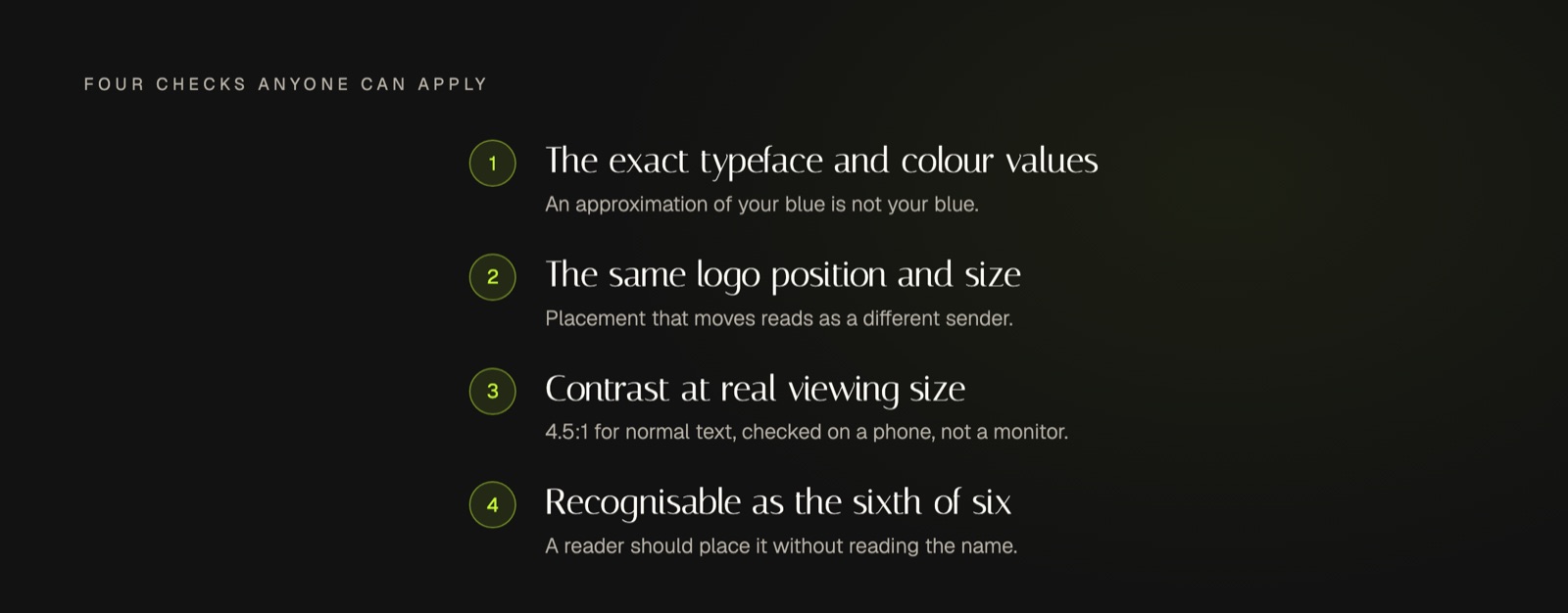
A standard beats a preference, because a standard can be applied by someone who is not you. Four checks cover most of it.
Does it use your actual typeface and your actual colour values, not an approximation. Does the logo sit in the same place, at the same size, every time. Does the text pass the contrast floor at the size it will really be viewed. And would a reader who saw your last five posts recognise this as the sixth without reading the name.
None of those are aesthetic judgments. All four can be checked by a person with no design training, which is the point. This is the same argument that sits underneath a documented brand blueprint: decisions recorded once, applied every time, rather than re-litigated per post. The same logic drives a workable content strategy, and it is why consistency is a systems problem rather than a talent problem for most founders producing their own content.
Key Takeaways
- Generation is solved. Consistency across a set is not.
- A model has no memory of your last post, so recognition cannot emerge from prompting.
- Contrast is checkable: 4.5:1 for normal text, 3:1 for large.
- Execution work compresses under AI. Judgment work does not.
- In the United States, prompts alone do not make you the author of the output.
- Judge output against a written standard, not against taste.
Frequently Asked Questions
Is there an AI that does graphic design?
Yes, several, and most produce competent single assets from a written brief. The limitation is not quality on any one piece. It is that each generation starts fresh, so nothing carries your typeface, colour values and logo placement forward unless a separate step enforces them.
Can ChatGPT do graphic design?
It can generate images and suggest layouts, and it is genuinely useful for exploring directions quickly. It is not a layout tool with typographic control, so treat the output as a draft to react to rather than a finished asset ready to publish in your brand.
Is it legal to sell designs made by AI?
Selling is generally not the issue. Ownership is. The United States Copyright Office has concluded that prompts alone do not confer authorship, so purely generated material may carry no copyright protection you can enforce. Human shaping of the work is what creates something protectable.
Conclusion: Judge the Set, Not the Post
The argument against AI in design used to be that the output looked bad. That argument has expired. The current failure is quieter and more expensive: fifty competent posts that do not look like they came from the same company.
So stop assessing one graphic at a time. Put a month of output side by side and ask whether a stranger would read it as one brand. If the answer is no, the fix is not a better prompt or a different tool. It is writing down what your brand looks like, and putting something in the way that checks every post against it before it goes out. If that sounds like the part of your week that keeps slipping, it is worth a look at how a system handles it instead.