Use AI for content creation to compress the production work, then put a person on every decision that carries your name. Machines are fast at drafting, resizing and repurposing. They are poor at knowing what is worth saying, and worse at sounding like you.
TL;DR: AI for content creation earns its place on volume and variation, never on taste. Hand it the drafting, the variations and the resizing, and hold on to the brief, the voice and the final yes. Google judges the output and not the method, and the EU AI Act hangs its disclosure exemption on a named person holding editorial responsibility.
What AI for Content Creation Actually Means
The phrase covers two different jobs that get sold as one. The first is generation: a model writes a draft, produces twenty versions of a caption, or cuts a long article into a week of posts. The second is orchestration: something decides what to make, in what order, for which channel, and whether the result is good enough to publish.
Tools are abundant at the first job. The second is where most content operations still fall over.
What is AI for content creation? AI for content creation is the use of machine models to produce and adapt marketing material: drafting copy, generating variations, resizing assets per channel and repurposing one idea into many formats. The strategy, the voice definition and the final approval still sit with a person.
That split matters because the two jobs fail differently, and the second failure is quieter. A weak generator produces text you can see is weak. A missing orchestration layer produces a perfectly reasonable post that nobody needed, published on a Tuesday because the calendar had a gap.
Where the Compression Actually Happens
Two things genuinely compress when a machine is involved, and it is worth being precise about which two.
- Production time. A first draft arrives in the time it used to take to decide how to open, and the hours saved move to editing.
- Personalisation. One argument can be rewritten for several audiences and every channel worth being on, at close to the cost of writing it once.
Two things do not compress at all. Judgement about what is worth publishing stays exactly as expensive as it was, because it depends on knowing the business, the customer and what has already been said. Voice stays expensive for the same reason. It is a set of specific choices, and a model asked to guess them will return the average of everyone who has ever written on the topic.
The practical consequence is that the bottleneck moves. When producing was slow, the constraint was capacity, and the sensible answer was to publish less. When producing is fast, the constraint is choosing, and publishing less stops being a concession and becomes the decision the whole system turns on.
The machine made volume cheap. It did not make deciding cheap, and deciding is what readers are responding to.
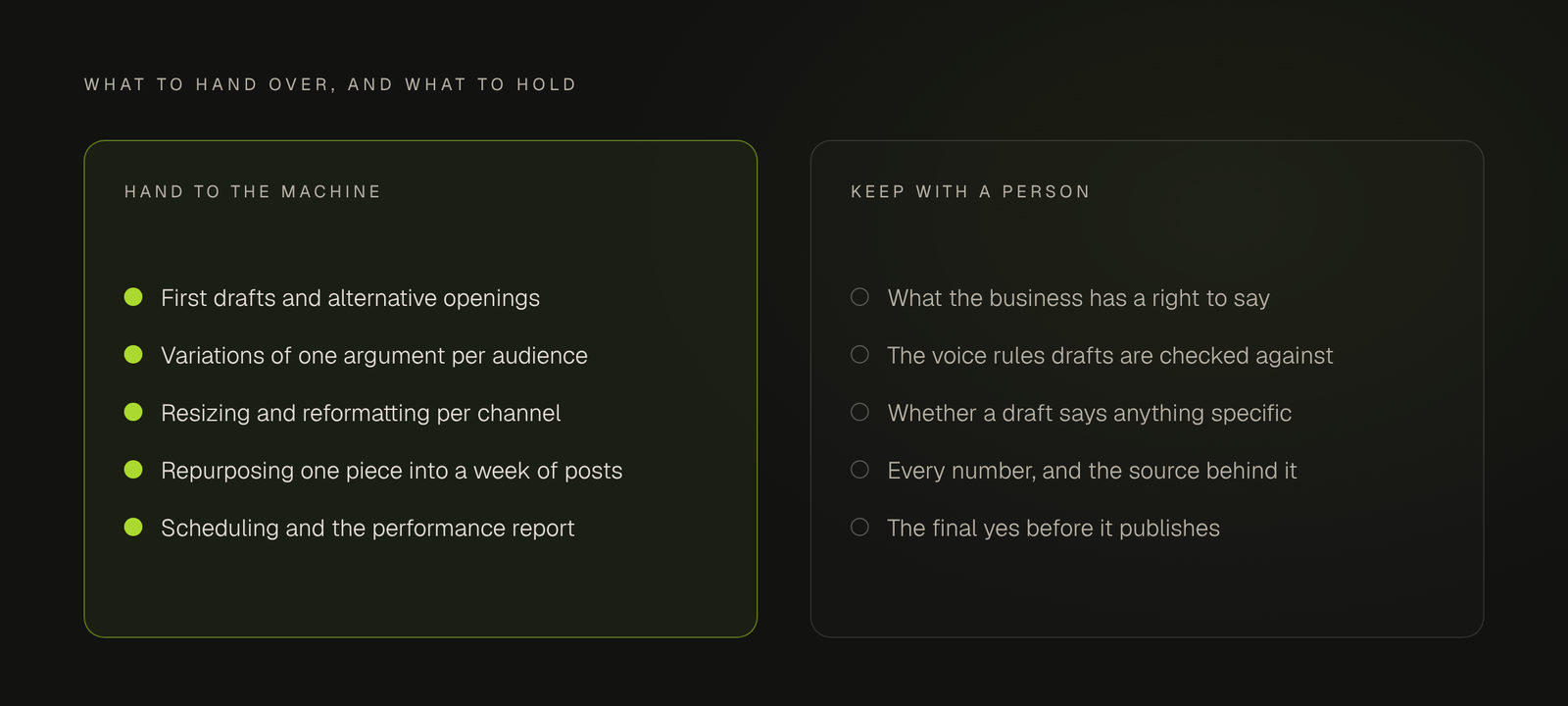
Most disappointment with AI for content creation comes from expecting the second pair to compress along with the first. The tool gets blamed for a gap that was always going to need a person in it.
The Four Stages of AI for Content Creation
Operations that hold up over months run the same four stages in the same order, whatever the tooling underneath. Naming them is what makes it possible to say where a machine is allowed to act on its own.
| Stage | What the machine does well | What a person decides |
|---|---|---|
| Define | Nothing without the inputs. | Positioning, audience, voice rules, visual identity. |
| Plan | Group topics, cluster keywords, propose an order. | Which topics the business has a right to own. |
| Produce | Draft, vary, resize, repurpose, caption. | Whether the draft says anything specific and true. |
| Publish | Schedule, format per channel, report back. | The final yes, and what the numbers change next week. |
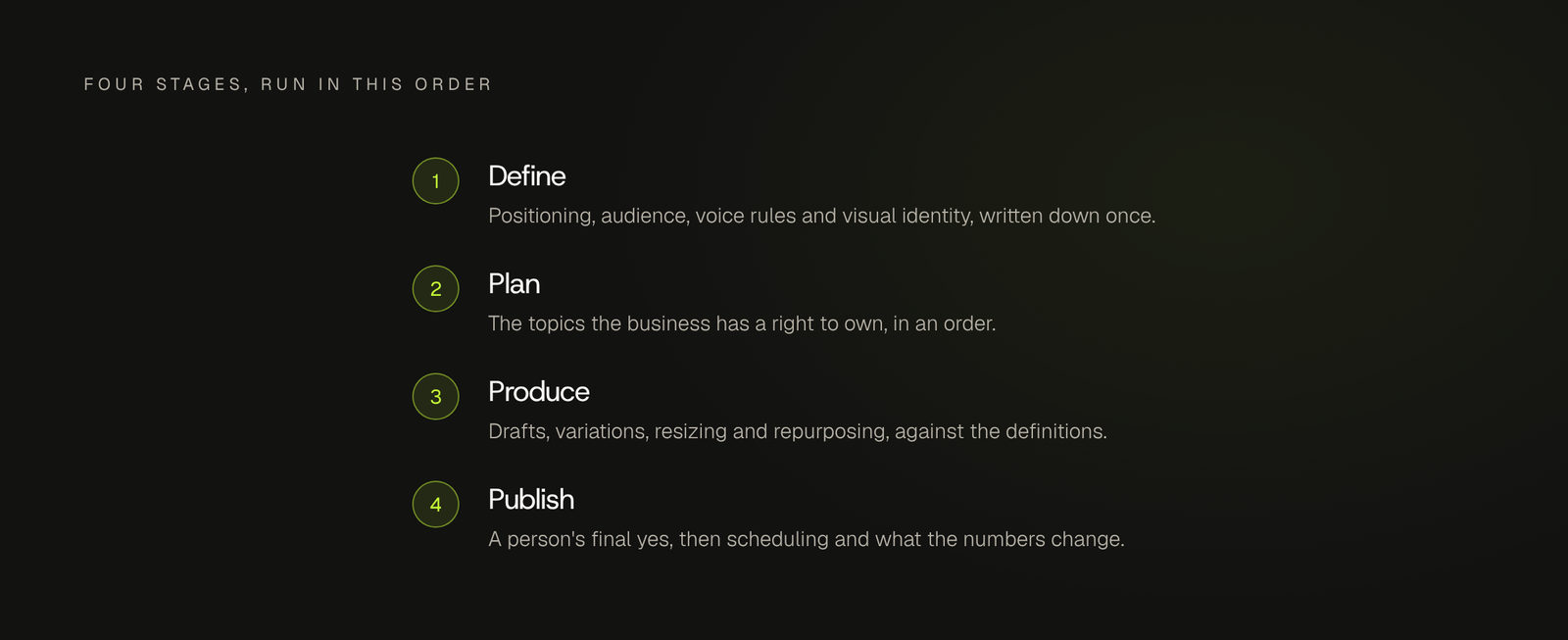
The order is the part people skip. Planning before defining produces a calendar full of topics nobody at the company can speak to with authority. Producing before planning produces volume with no shape, which is the most common way automating a content creation workflow goes wrong.
A useful test for any tool you are considering: ask which of the four stages it actually covers. Most cover Produce, some cover Publish, and the two that decide whether any of it was worth doing are left to you.
Voice Is the Part That Does Not Compress
Ask a general model to write in your voice and it will write in the voice of the topic. That is the honest description of what happens: it returns the median of everything written about your subject, which reads as competent, readable and anonymous.
The fix is not a better prompt typed fresh each time. It is writing the voice down once, as rules a machine can check itself against.
- Vocabulary the brand uses, and the words it refuses.
- Register: how formal, how warm, how direct.
- Punctuation and formatting rules, down to whether em dashes are allowed.
- Claims the brand will not make, which is the rule that saves you most often.
Written down, those stop being taste and start being checkable. That document is what we call a Blueprint, and holding it is the part content creation automation gets wrong most often, by treating voice as a style setting instead of a specification.
There is a second reason to write it down that has nothing to do with machines. A voice that lives in one founder's head cannot be handed to a freelancer, a new hire or a designer either.
Why Volume Without a Gate Produces Work Nobody Reads
The cheapest thing a content system can do is publish everything it generates. It is also the fastest way to teach an audience to skip you.
Google's position here is narrower than either side of the argument usually allows. Its guidance says that using automation to generate content with the primary purpose of manipulating search rankings violates its spam policies, while appropriate use of AI is not against its guidelines at all. The same page puts the rest of it plainly: "Using AI doesn't give content any special gains. It's just content."
So the risk was never detection. The risk is that low quality AI content does what low quality human content has always done. It fills a page, earns nothing, and makes the next thing you publish a little less likely to be read.
A gate is a short list of questions somebody answers before a post goes out. Ours comes down to four.
- Does this say something specific the business can stand behind?
- Would a reader who already knows the basics learn anything?
- Does it sound like us when read aloud?
- Is every number in it traceable to a source we opened ourselves?
Anything that fails one of those gets fixed or dropped. A system that cannot drop its own output is not a system, it is a conveyor belt.
What the Reporting Should Change
The fourth stage produces numbers, and in most setups those numbers go into a monthly summary nobody acts on. That is a broken loop, and it is the whole difference between a content system and a content treadmill.
Closing it takes one decision written down in advance: what result would make you publish more of something, and what result would make you stop. Without that, performance data turns into an argument about whether the numbers are good, which never resolves.
- More of this. A format or topic that earned attention from the right people, not simply the most people.
- Same again, fixed. The argument landed and the execution let it down.
- Stop. It performed, and it attracted an audience that will never buy.
Those three verdicts are enough to steer a quarter. A machine can produce the report and even propose which bucket each post belongs in, but the verdict is a judgement about the business, so it belongs with the same person who holds the final yes.
Disclosure, Copyright and Editorial Responsibility
Two legal points shape how a sensible operation is built, and both reward the same structure.
On ownership, the US Copyright Office concluded that the outputs of generative AI can be protected by copyright only where a human author has determined sufficient expressive elements, and that supplying prompts alone does not meet that bar. It also confirmed that using AI to assist creation, or including AI-generated material inside a larger human-authored work, does not block protection. The practical reading is simple: the more of the expressive decisions a person actually makes, the more of the result is yours to own.
On disclosure, the EU AI Act requires that AI-generated text published to inform the public on matters of public interest be disclosed as such, and then exempts content that has been through human review or editorial control where a named person holds editorial responsibility for the publication. Those transparency obligations applied from 2 August 2026.
Both rules point at the same arrangement. A person decides, a person reviews, a person is answerable for what went out. Build it that way and most of the compliance question answers itself.
Building It Without Hiring for It
The arrangement above needs somebody holding the brief and the final yes. That is a real job, and for most small teams it is a fraction of a job balanced on top of everything else, which is why it quietly does not happen.
Three ways to close that gap, in descending order of how much of your week they cost.
- Run it yourself with general tools. Cheapest in cash, most expensive in attention, and the first thing dropped in a busy month.
- Buy the production and keep the judgement. A freelancer or agency drafts, you brief and approve. The briefing is the cost people underestimate.
- Buy a system that already holds the definitions, so the voice, positioning and visual rules live in one place and the weekly output is produced against them.
Whichever you pick, write the definitions down first. An AI content strategy that exists only in somebody's head cannot be handed to a machine, a freelancer or a new hire, so the handover problem shows up again every time anything changes.
Key Takeaways
- AI for content creation compresses production and personalisation. It does not compress judgement or voice.
- Write the voice down as checkable rules, not as a prompt you retype each time.
- Google judges the output and not the production method. Volume with no gate still earns nothing.
- Copyright protection follows human expressive decisions, so prompts on their own own nothing.
- The AI Act's disclosure exemption depends on a named person holding editorial responsibility.
- Ask any tool which of the four stages it covers before you buy it.
Frequently Asked Questions
Does Google Punish AI Content?
No. Appropriate use of AI is not against Google's guidelines, and its own guidance says that using AI gives content no special advantage either way. What breaks its spam policies is automation used primarily to manipulate search rankings. The output is judged on whether it is useful, original and trustworthy.
How Much AI-Generated Content Is Acceptable?
No platform publishes a threshold, and any percentage you have seen quoted is somebody's rule of thumb rather than a rule. The workable test is ownership. A person sets the brief, reviews the draft and answers for what goes out. Judge the proportion by how much of the thinking was yours.
Is AI Content Real Content?
To a reader and to a search engine, yes. Google's guidance reduces it to one line: it is just content, and it succeeds or fails on whether it is helpful and original. The question worth asking is not how a draft was produced, but whether anybody needed it.
The Bottom Line
Treat AI for content creation as a production capability and never as an editorial one. Give it the drafting, the variations and the resizing. Keep the brief, the voice and the final yes with a person who can answer for all three. The operations that look easy from outside are the ones where those two halves were separated on purpose.
If holding that line every week is the part that keeps slipping, our done-for-you content service is worth a look: the definitions live in one place, and the week's posts arrive finished.