An AI brand kit generator is good at two jobs: producing many options quickly, and applying a rule you have already chosen without ever getting bored of it. It is poor at the job in between, which is deciding which rule deserves to exist. Generated kits pass a specification check and fail a recognition check. The fix is to make four brand decisions yourself, hand them over as constraints, and treat the output as production work rather than as identity.
Type a business name into a generator and about sixty seconds later you have a logo family, exact hex codes, a font pairing and a set of social templates. Every field a brand kit is supposed to have is filled in. That is genuinely useful, and it is also why these kits fail quietly: completeness is easy to check, and completeness is not what a kit is for. The specification-first view of a brand kit sets out the four parts one needs. This article is about which of them a machine can be trusted to fill.
What an AI Brand Kit Actually Produces
Definition. An AI brand kit is a generated set of identity assets, usually a logo family, colour values, a type pairing and some ready-made layouts, produced from a short prompt or an existing website address. It is an output, not a system. Nothing in it records why a choice was made, so it cannot tell you what to do the first time an unanticipated format turns up.
Audit the delivery before the design, because the delivery is where the gaps are concrete. Most generators hand back raster images, and a logo as a fixed-size PNG will not survive a banner or a favicon; the four parts in build order begin with a vector master for that reason. Type pairings are named but not licensed: a typeface name arrives with no statement of whether you may use it commercially. Export presets, the part that saves the most time week after week, are almost never included.
The Spec Check and the Recognition Check
The specification check asks whether every rule carries a value. Is the blue a hex code or the word "blue"? Is the heading size a number with a named role beside it? Is there a rule for which logo variant sits on a dark background? Generated kits pass this outright, because filling defined fields is what a generator does well. It is the same reason a template can list the decisions without making any of them.
The recognition check asks something harder. Strip the name off one of your posts and show it to someone who has seen your work three times. Would they know it was you? That is not a question about beauty. It asks whether the kit holds one decision a category-average generator would never have made, and a generator works from the category because the category is all it was given. Ask for a coaching practice and you get what coaching practices look like.
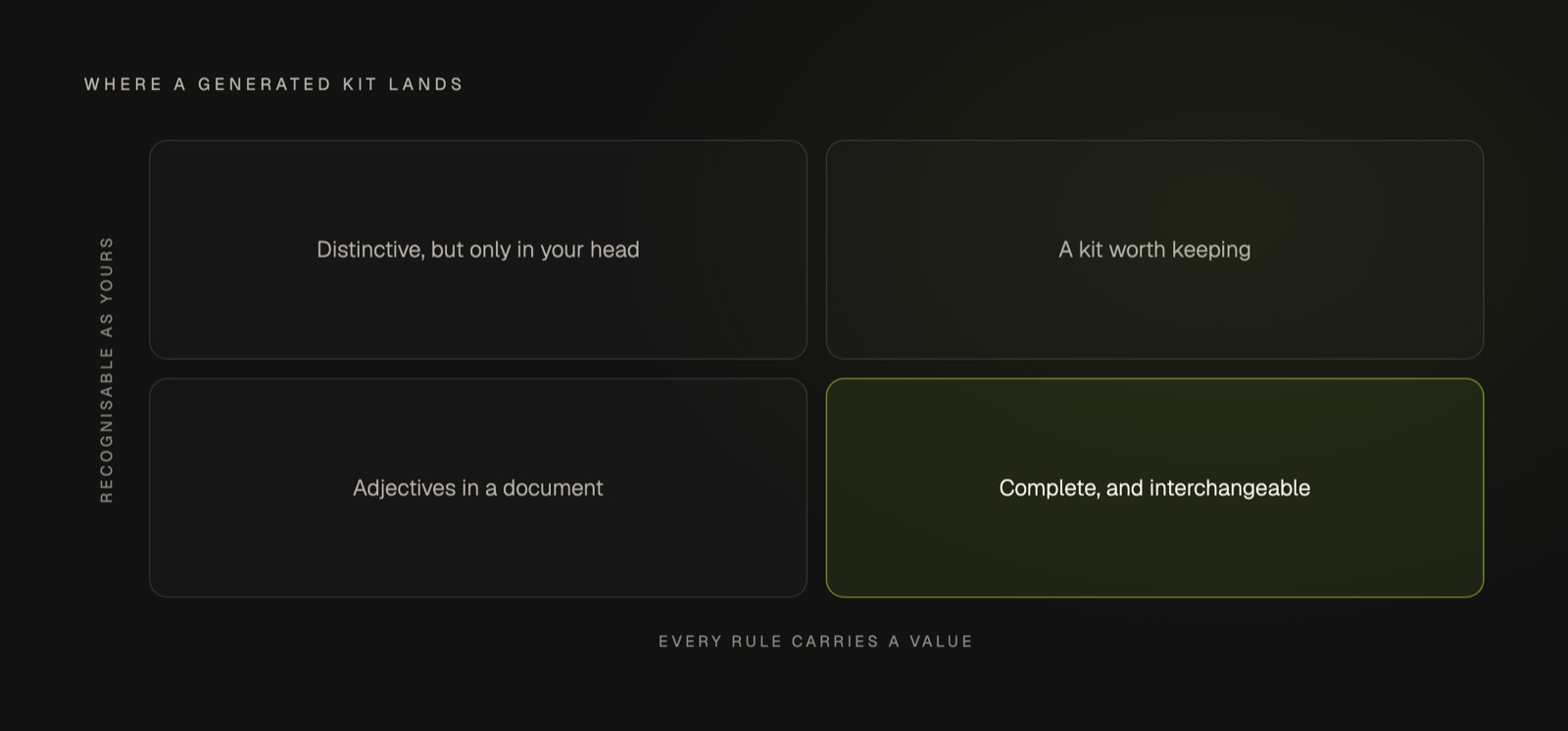
So most AI brand kits land in one quadrant: fully specified, entirely interchangeable. That is fixable, and it beats the opposite corner, where a distinctive look lives in the founder's head and cannot be handed to anyone.
Decide These Four Things Before You Generate
The way to get something usable out of a generator is to stop asking it to decide and start asking it to execute. Four decisions stay with you.
- Who it is for. Not the industry, the specific reader. "Independent financial advisers who hate looking like a bank" is a constraint a model can work inside. "Professionals" is not.
- What you refuse. Exclusions shape more than inclusions do. No stock gradients, no rounded sans-serif, no photography of people in offices. A refusal is the cheapest way out of the average.
- The one carried element. A single thing that repeats across every asset: a crop, a rule line, a fixed corner radius, one unexpected colour used sparingly. Recognition comes from repeating one specific thing, not four coordinated ones.
- Where it has to work. The real formats and their native sizes, listed before you generate. A mark that only reads at presentation scale is a mark you will redraw.
Write those four down, then feed them in as constraints. A generator given constraints produces options inside them, which is the task it is good at. Capturing the decisions once, before anything is designed, is the idea behind the Blueprint we build for every brand.
Who Owns an AI Brand Kit?
Most guides skip this. In the United States, the Copyright Office's registration guidance for works containing AI-generated material states that "copyright can protect only material that is the product of human creativity", and that "when an AI technology determines the expressive elements of its output, the generated material is not the product of human authorship". Applicants also carry "a duty to disclose the inclusion of AI-generated content in a work submitted for registration". A mark the model composed on its own is, on that guidance, not yours to register.
Trademark is a separate question with a more encouraging answer. The United States Patent and Trademark Office says strong trademarks are "typically creative or unique, setting you apart from your competitors", while "weak trademarks are hard to protect against competitors and often are not federally registrable". That test concerns the mark's relationship to what you sell, not its visual style, so it is not a design critique. What it asks for underneath is what the recognition check asks for.
Rules differ by jurisdiction and none of this is legal advice. The practical conclusion survives translation: the more of the final mark you chose and reworked yourself, the better your position under both.
Frequently Asked Questions
What is the best AI brand kit generator?
The useful test is not how good the first screen looks, it is what happens after it. Can you overwrite the generated palette with your own hex values and have every template follow? Can you export a vector master rather than a fixed-size image? Are the rules editable, or only the results? A tool that lets you replace its decisions beats one with a prettier default you cannot change.
Can you legally use a logo created by AI?
Using it is a matter of the tool's licence terms, worth reading before you commit a business name to the mark. Owning it is separate. Under the guidance above, material whose expressive elements were determined by the model is not protected by copyright, so nobody is stopped from reproducing it. Redrawing and substantially reworking the mark yourself, with a record of the changes, moves it back toward protectable.
How much should an AI brand kit cost?
Generated kits sit at the cheap end, usually a one-time fee or a design subscription that bundles the editor with it. The figure that matters is not that price, it is what you spend afterwards. Budget for the two things generators leave out: a vector redraw of the final mark, and a licence for the typeface you settle on. A kit that forces a full remake six months later was not cheap.
The Bottom Line
A generated kit closes the distance between nothing and specified, and it closes it in an afternoon. It cannot close the distance between specified and recognisable, because that gap is made of decisions about who you are for and what you refuse. Make those, hand them over as constraints, then let the generator do what it is genuinely better at than you are: applying the same rule, in every format, week after week.